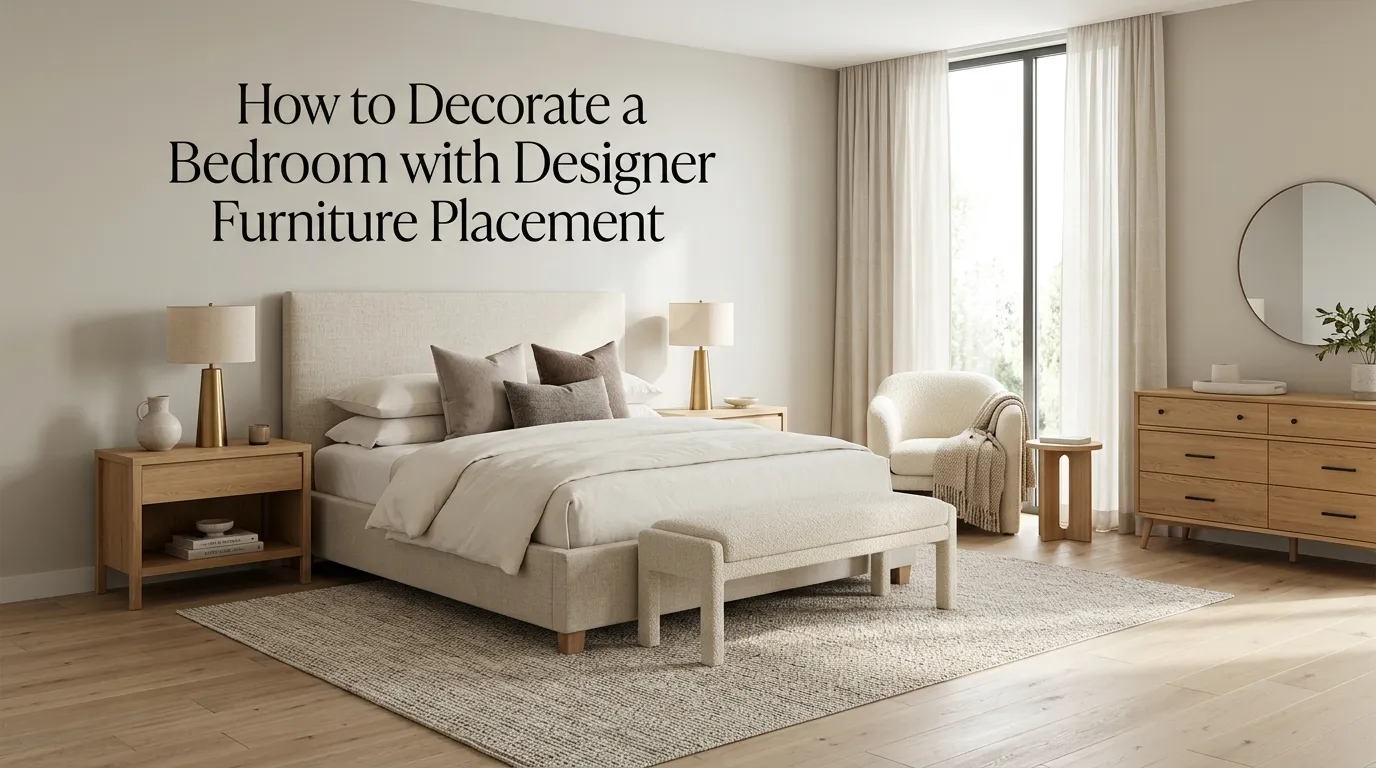
How to Decorate a Bedroom with Designer Furniture Placement
A beautifully decorated bedroom is not only about choosing attractive furniture, colors, or bedding. The way those pieces are positioned can completely change how the room looks and functions. Even expensive furniture can feel awkward when the bed blocks a pathway, the dresser crowds a doorway, or the nightstands are squeezed into corners that make the room difficult to use.
Designer furniture placement takes a different approach. Instead of filling the room first and figuring out the layout afterward, you begin by considering circulation, proportions, focal points, natural light, architectural features, and everyday routines. The result can feel more balanced and intentional without requiring a complete renovation.
One thing I’ve noticed when arranging bedrooms is that the best layouts usually leave some breathing room. You do not need to use every available corner. Empty space around furniture can make a bedroom feel calmer, more sophisticated, and easier to navigate.
The bed is usually the starting point, but it is not the only consideration. Nightstands, dressers, benches, chairs, mirrors, rugs, lighting, and artwork all need to work together. A layout that looks beautiful in a photograph also needs to make sense when you’re walking through the room at night, opening drawers, making the bed, or getting dressed in the morning.
The ideas below will help you approach your bedroom like a designer. Whether you’re working with a spacious primary bedroom, a narrow guest room, or a compact apartment bedroom, these principles can help you create a layout that feels comfortable and polished.
You may not need new furniture at all. Sometimes the biggest transformation comes from moving what you already own.
Table of Contents
1. Start With The Bed
Build the entire bedroom arrangement around the room’s most important furniture piece.
2. Create Clear Pathways
Use furniture placement to make movement through the bedroom effortless.
3. Balance Both Sides
Create visual symmetry around the bed without making the room feel overly formal.
4. Consider Room Proportions
Choose furniture placement that responds to the bedroom’s actual dimensions.
5. Frame The Bed
Use rugs, benches, lighting, and artwork to give the sleeping area a finished appearance.
6. Use Furniture Zones
Divide the bedroom into practical areas for sleeping, dressing, reading, and relaxing.
7. Work With Windows
Arrange furniture to respect natural light while keeping the room functional.
8. Style The Dresser
Position and decorate storage furniture so it becomes part of the overall design.
9. Add A Seating Area
Use a chair or bench to create a useful secondary destination.
10. Layer The Lighting
Use furniture placement to support multiple sources of comfortable bedroom lighting.
11. Edit The Layout
Remove unnecessary pieces and refine the room until everything feels intentional.
1. Start With The Bed
Quick Benefits
- Establishes the room’s primary focal point
- Makes the rest of the layout easier to plan
- Improves visual balance
- Helps determine where nightstands belong
- Creates a clear starting point for decorating
Why It Works
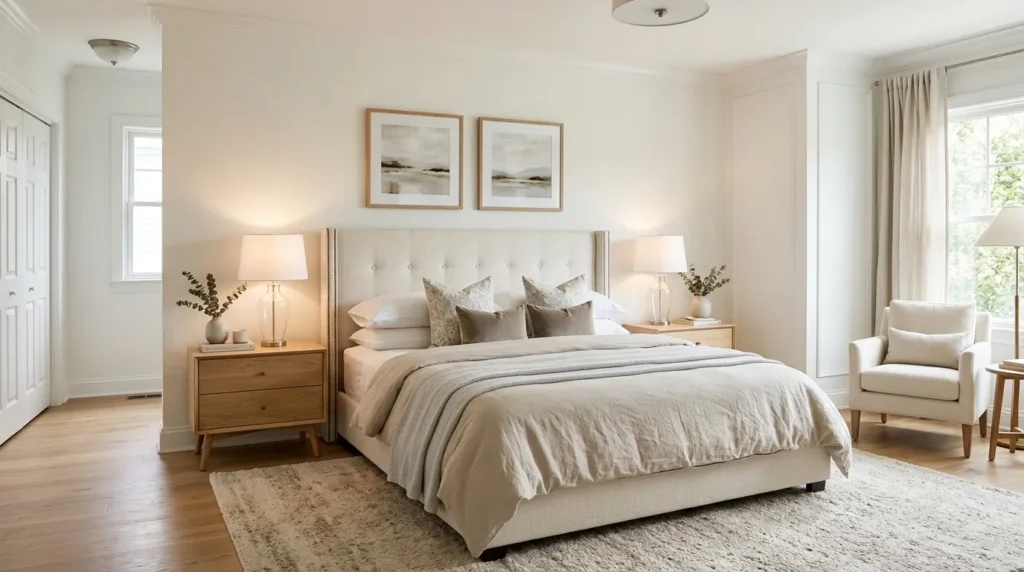
In most bedrooms, the bed is the largest and most visually important piece of furniture. It naturally becomes the anchor of the room, which means its placement affects almost everything around it.
A common decorating mistake is choosing furniture individually without considering how the pieces relate to one another. A beautiful bed may look impressive in a showroom but feel completely wrong when placed against a wall that interrupts the room’s circulation or competes with a doorway.
Start by identifying the strongest wall in the bedroom. In many rooms, this is the wall opposite the entrance or the wall that naturally faces you when you walk in. If there is a fireplace, architectural feature, or particularly attractive view, the layout may need to respond to that instead.
The bed does not always have to be centered on the largest wall, but centering it often creates an immediate sense of order.
How To Style It
Place the bed where it can become the visual anchor without blocking doors, closets, windows, or major walkways.
If the room allows it, leave enough space on both sides of the bed for comfortable movement and nightstands. Matching nightstands create symmetry, but mismatched pieces can also work when their visual weight is similar.
Avoid automatically pushing the bed into the corner just because the room is small. While this may sometimes be necessary, it can make the bedroom feel more like a storage arrangement than a thoughtfully designed space.
Once the bed is positioned, stand at the doorway and look at the room from several angles. The layout should feel balanced from the moment you enter.
2. Create Clear Pathways
Quick Benefits
- Makes the bedroom easier to navigate
- Prevents furniture from feeling crowded
- Improves everyday functionality
- Makes the room appear more spacious
- Creates a cleaner visual flow
Why It Works
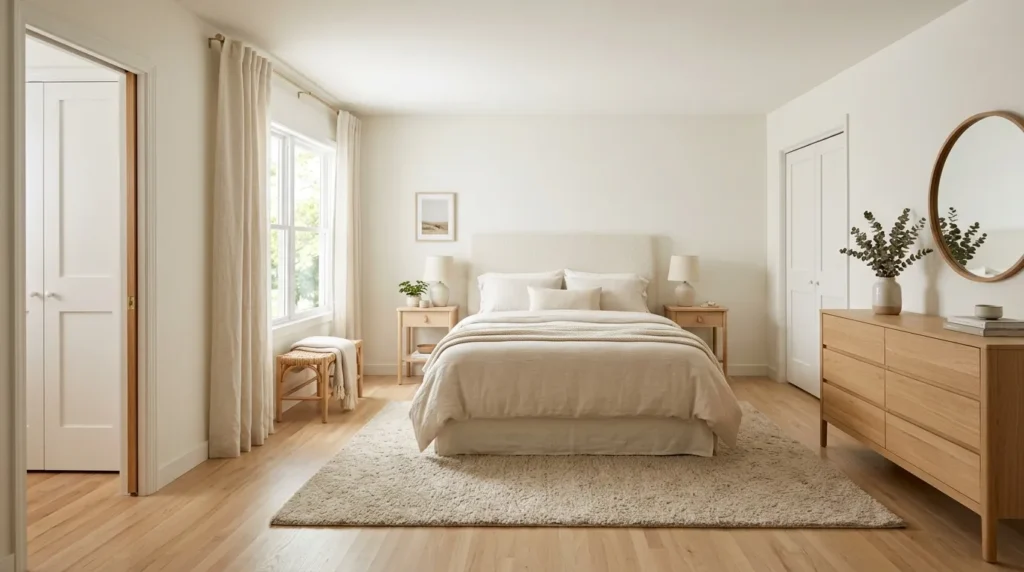
A bedroom can have beautiful furniture and still feel uncomfortable if you have to squeeze between pieces to get around. Designers pay close attention to circulation because movement is one of the easiest ways to tell whether a layout genuinely works.
Think about how you move through the bedroom during a normal day. You may enter from a hallway, walk toward the closet, open dresser drawers, get into bed, or move between the bed and bathroom. Those routes should remain reasonably clear.
A visually open pathway also changes how the room feels. When the eye can travel easily across the floor, the bedroom appears less crowded.
This is particularly important in smaller bedrooms, where every piece of furniture has a greater impact on circulation.
How To Style It
Begin by identifying the room’s primary walking routes. Keep the area directly in front of the bedroom door as open as practical.
Check the space around the bed and make sure nightstand drawers and dresser drawers can open without hitting another piece of furniture.
Avoid placing a large bench, ottoman, or accent chair in a pathway simply because there is an empty corner. Empty space is useful when it allows movement.
For a narrow bedroom, consider arranging larger furniture along the longest walls and keeping the center of the room relatively open.
If you’re unsure whether a piece is too large, use painter’s tape to mark its footprint on the floor. Walk around the outline for a day before committing to the arrangement.
3. Balance Both Sides
Quick Benefits
- Creates visual harmony
- Makes the bed feel centered
- Improves nighttime functionality
- Provides room for lighting
- Gives the bedroom a polished appearance
Why It Works
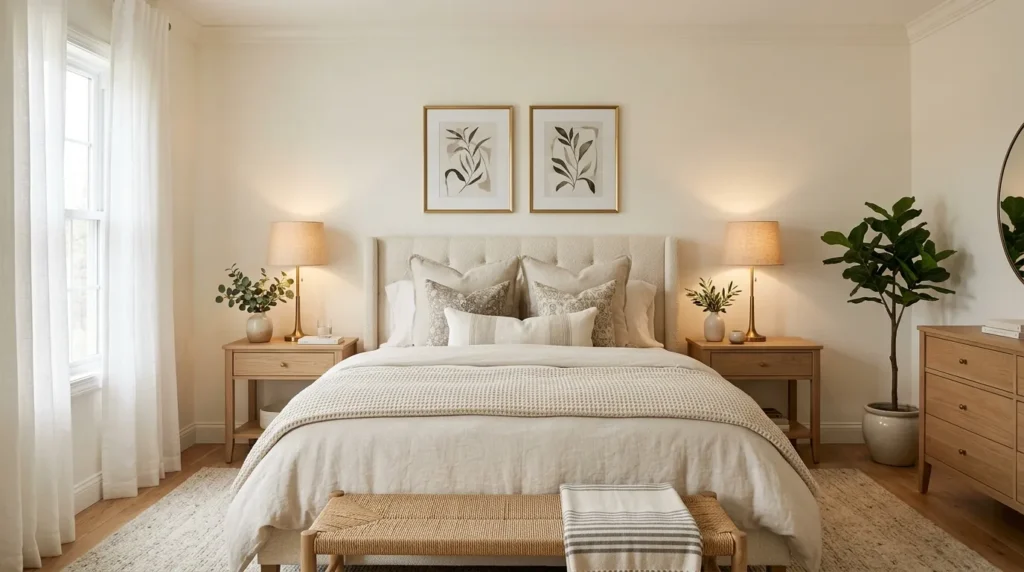
Symmetry is one of the simplest design principles for creating a bedroom that feels finished. When the bed is positioned centrally, matching or visually balanced elements on either side can make the entire arrangement feel intentional.
This does not mean everything has to match perfectly. Designers often use visual balance rather than strict duplication.
For example, one side of the bed might have a traditional nightstand while the other has a small chest. If both pieces have similar height and visual weight, the arrangement can still feel balanced.
Lighting is another important part of this equation. Two bedside lamps can frame the bed and provide practical reading light while reinforcing the symmetry.
How To Style It
Start with two nightstands that are approximately proportional to the bed. They do not need to be identical, but they should provide enough surface area for everyday essentials.
Add matching lamps if you want a classic appearance. For a more collected look, use different lamps with similar heights or finishes.
Keep the tops of nightstands relatively simple. A lamp, small tray, book, or vase may be enough.
If one side of the bed has a window or architectural limitation, work with the asymmetry rather than fighting it. A narrow floating shelf can sometimes replace a traditional nightstand when space is limited.
The goal is not perfection. The goal is a bedroom that feels visually stable.
4. Consider Room Proportions
Quick Benefits
- Prevents oversized furniture from dominating
- Helps small bedrooms feel less crowded
- Makes large rooms feel more complete
- Improves visual balance
- Creates a more professional appearance
Why It Works
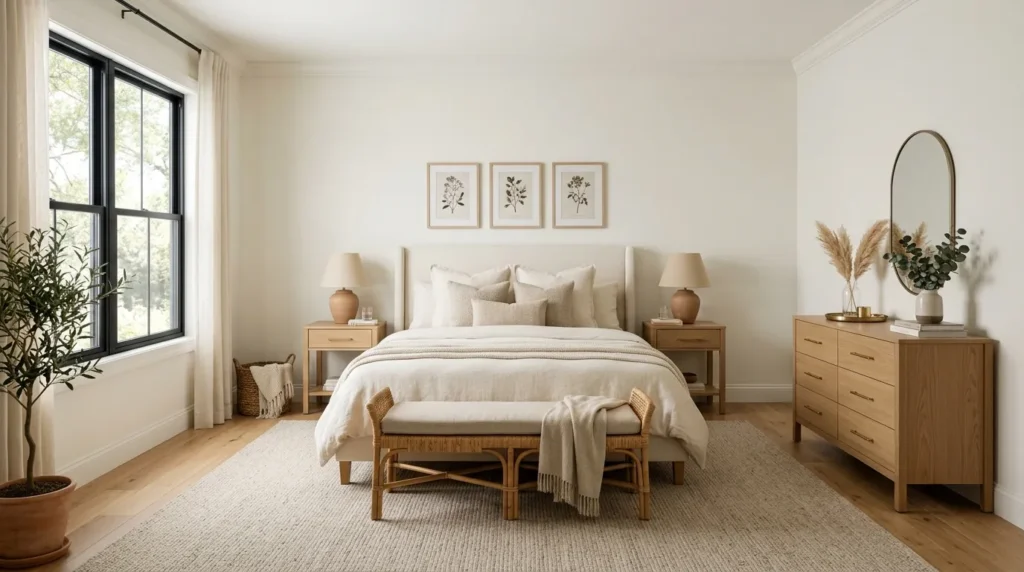
Furniture size should respond to the room rather than simply to personal preference. A massive upholstered bed can overwhelm a compact bedroom, while tiny furniture can make a large primary bedroom feel unfinished.
This is where proportion becomes more important than individual style.
Before purchasing furniture, measure the room, doors, windows, and major architectural features. Then compare those measurements with the furniture dimensions.
Think beyond the footprint of each piece. A tall headboard affects the visual height of the room. A deep dresser can make a narrow passage feel smaller. A wide nightstand can crowd a doorway even when the bed itself fits comfortably.
Designers consider how furniture occupies both physical and visual space.
How To Style It
For a small bedroom, prioritize fewer pieces with useful functions. A streamlined bed, narrow nightstands, and compact dresser may be more effective than several smaller pieces.
In a large bedroom, avoid pushing all furniture against the walls. Use a bench, seating area, or rug to create distinct zones and make the room feel intentionally furnished.
Keep tall pieces away from areas where they might visually close off a window.
When mixing furniture styles, pay attention to scale. A substantial upholstered bed can work with a lighter nightstand, but the difference should feel deliberate.
Before buying anything, sketch the room on graph paper or create a simple digital floor plan. Even a rough plan can reveal problems before furniture arrives.
5. Frame The Bed
Quick Benefits
- Creates a finished focal point
- Adds softness and texture
- Defines the sleeping zone
- Helps connect furniture visually
- Makes the room feel more layered
Why It Works
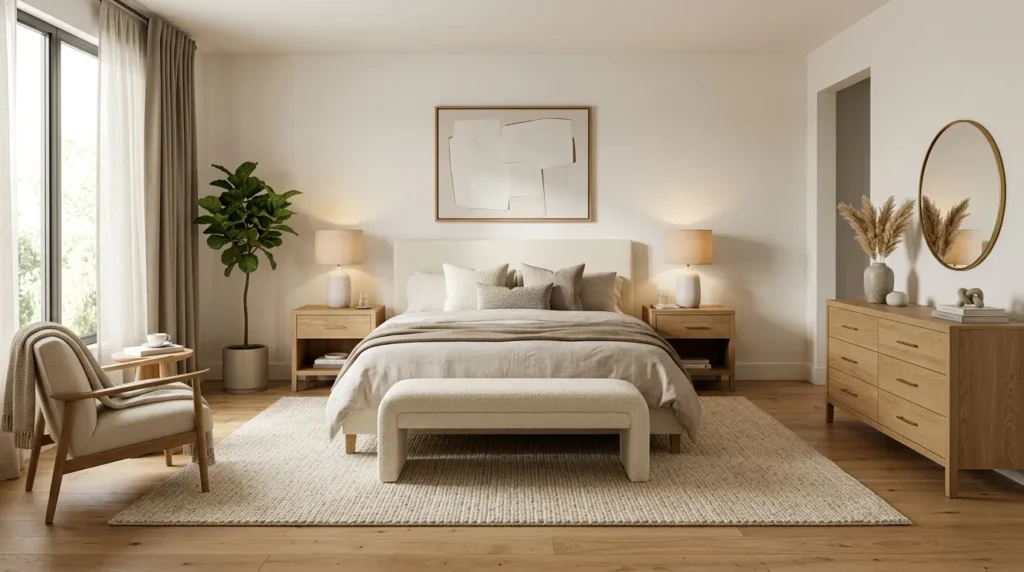
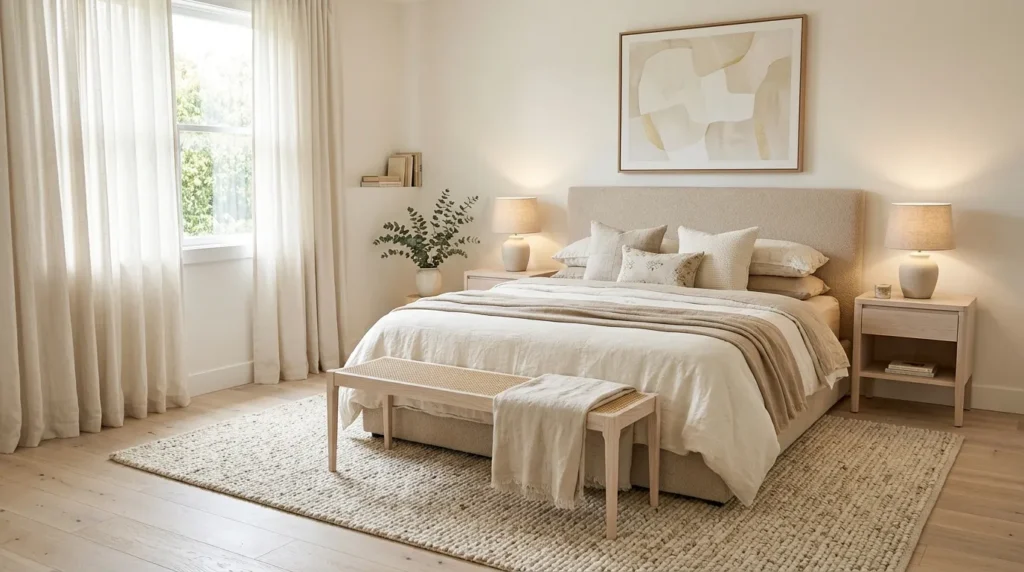
A bed can look disconnected from the rest of the bedroom when it sits alone. Rugs, benches, artwork, nightstands, and lighting can visually frame the bed and turn it into a cohesive composition.
The area rug is especially important. It creates a visual foundation beneath the sleeping area and helps connect the furniture pieces.
Artwork above the headboard can establish another layer, while bedside lighting reinforces the bed’s position as the center of the room.
These elements work together to create a sense of enclosure without physically closing the space.
How To Style It
Choose an area rug that extends beyond the sides of the bed when possible. In larger rooms, allowing the rug to extend farther into the surrounding space can help connect the bed with nearby furniture.
Place a bench at the foot of the bed if there is enough clearance to use it without disrupting circulation.
Above the bed, choose artwork or a mirror that is appropriately scaled to the headboard. One oversized piece can often look more sophisticated than several tiny pieces.
Keep the bedding palette connected to the rug and window treatments. Repeating two or three colors throughout the composition helps everything feel intentional.
6. Use Furniture Zones
Quick Benefits
- Gives every area a purpose
- Makes large bedrooms more functional
- Prevents furniture from feeling randomly placed
- Supports different daily activities
- Creates a designer-inspired layout
Why It Works
A bedroom can serve several functions beyond sleeping. Depending on the size of the room, you may want space for reading, getting dressed, working, relaxing, or storing clothing.
Instead of placing furniture wherever there happens to be room, create small functional zones.
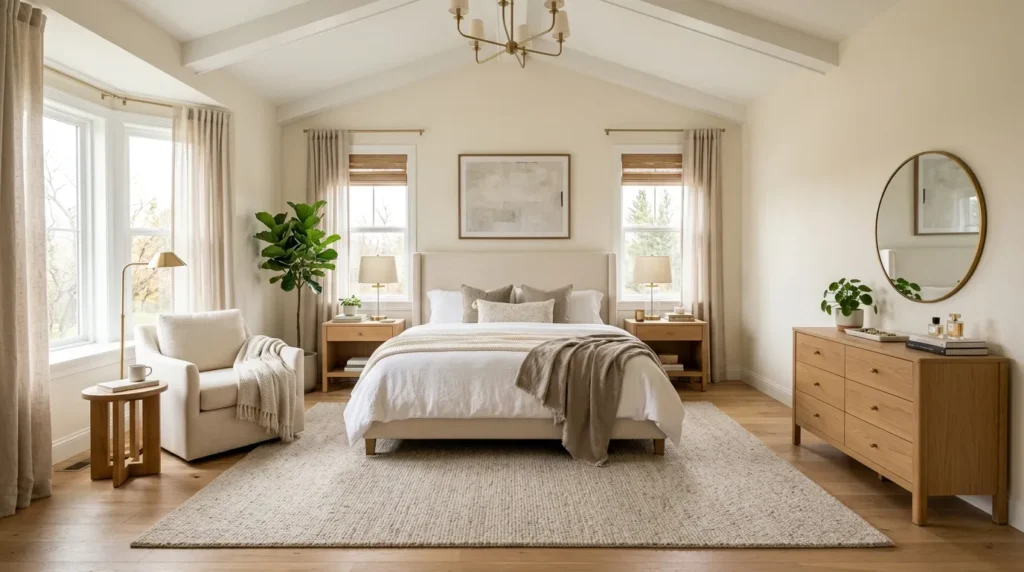
The sleeping zone centers on the bed. A dressing zone may include a dresser and mirror. A reading zone can consist of a chair, side table, and lamp.
This approach is especially effective in large bedrooms because it prevents the space from feeling like one enormous empty rectangle.
How To Style It
Start with the sleeping area and then identify unused areas around it.
A corner near a window can become a reading nook with an upholstered chair and floor lamp. A long empty wall may be suitable for a dresser and artwork.
If you work from your bedroom, keep a small desk visually separate from the sleeping area when possible. This can help maintain a distinction between work and rest.
Use rugs, lighting, or furniture orientation to define each zone without adding physical walls.
In smaller rooms, combine functions. A storage bench can provide seating and hidden storage, while a compact desk can double as a vanity.
7. Work With Windows
Quick Benefits
- Maximizes natural light
- Protects the room’s strongest features
- Creates better visual flow
- Supports a brighter atmosphere
- Prevents furniture from fighting architectural details
Why It Works
Windows are often the most valuable natural feature in a bedroom. They provide daylight, views, and a sense of connection to the outdoors.
Furniture placement should work with those qualities rather than unnecessarily blocking them.
This does not mean furniture can never sit near a window. In some bedrooms, a bed beneath a window is the most practical solution. The key is to consider how the furniture affects light, access, window treatments, and visual balance.
Natural light can also influence where you place a reading chair, dresser mirror, or workspace.
How To Style It
If possible, keep bulky furniture from covering a large portion of the window.
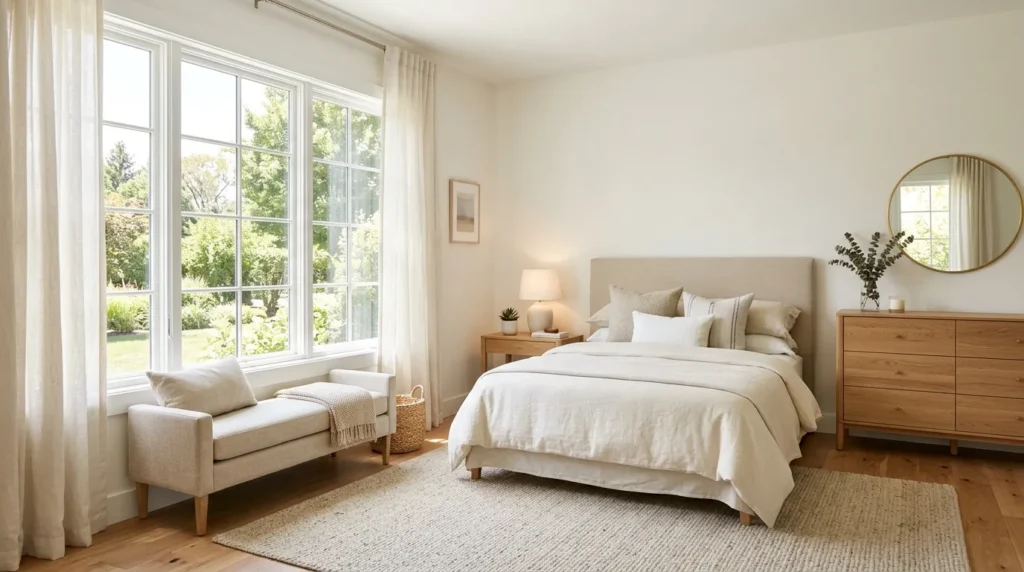
A low-profile bench can work beneath a window without blocking as much light as a tall cabinet.
If the bed must sit beneath a window, use a headboard that works with the proportions of the window and keep window treatments simple.
Place a reading chair near natural light when the location does not interfere with circulation.
Use curtains to frame the window rather than visually cutting it into pieces. Soft neutral curtains can make the entire wall feel taller and more cohesive.
8. Style The Dresser
Quick Benefits
- Turns storage into a design feature
- Creates a secondary focal point
- Adds useful organization
- Provides space for artwork and mirrors
- Helps balance the bedroom
Why It Works
A dresser is often treated as purely functional furniture, but its placement can have a significant effect on the bedroom’s visual composition.
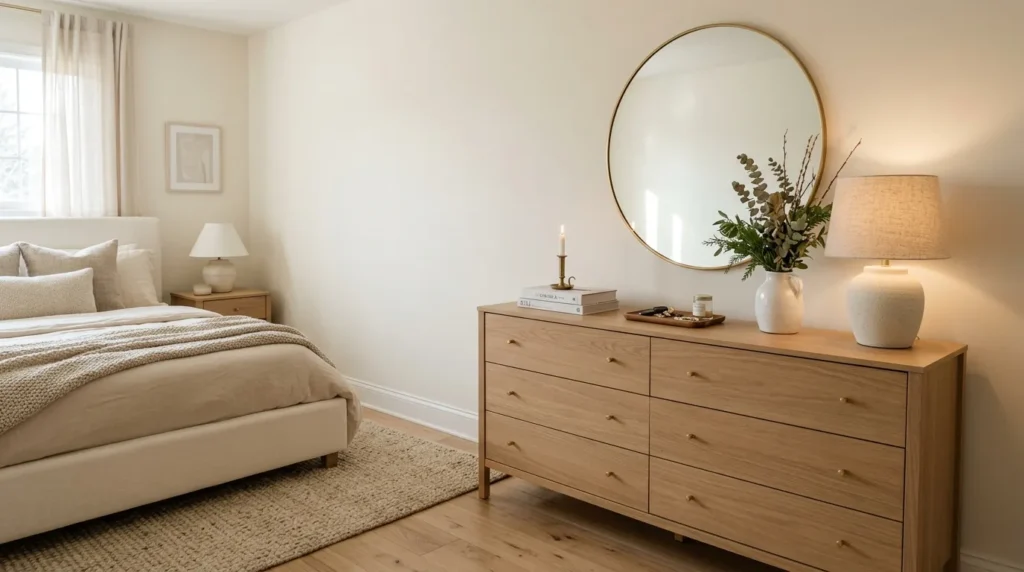
A well-positioned dresser can anchor an otherwise empty wall and provide an opportunity for artwork, a mirror, lighting, or decorative objects.
The key is avoiding excessive styling. Because dressers already contain multiple drawers and a substantial horizontal surface, too many accessories can quickly make the area feel heavy.
How To Style It
Position the dresser where drawers can open fully without blocking pathways.
A mirror above the dresser can add height and make the arrangement feel more complete. Alternatively, use one large piece of artwork.
Place a lamp on one side and a small decorative object or plant on the other for an asymmetrical but balanced look.
Keep some empty surface visible. A dresser does not need to become a display shelf.
If the bedroom is small, choose a dresser with a lighter visual profile or raised legs to make more floor visible.
9. Add A Seating Area
Quick Benefits
- Creates a dedicated relaxation space
- Makes larger bedrooms feel complete
- Adds functionality beyond sleeping
- Provides another styling opportunity
- Gives the room a more luxurious feel
Why It Works
A chair, bench, or small seating arrangement can make a bedroom feel more like a complete retreat rather than simply a place containing a bed.
In a large bedroom, a seating area also solves an important design problem: what to do with extra space.
However, seating should only be added when there is enough room to use it comfortably. Adding a chair simply to fill an empty corner can create unnecessary visual and physical clutter.
How To Style It
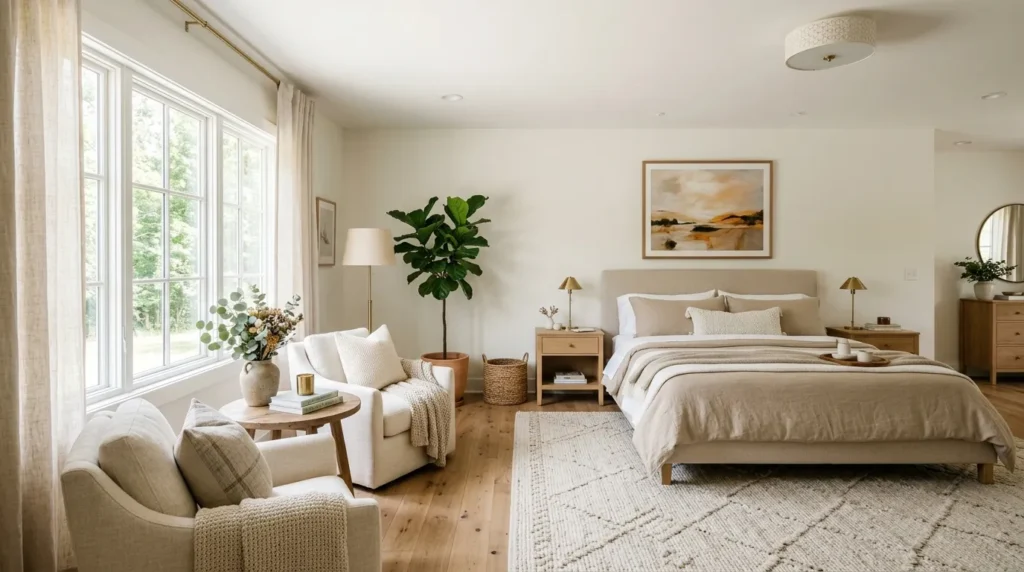
A single upholstered chair with a small side table works well in a corner near a window.
For a larger bedroom, two small chairs and a round table can create a comfortable conversation or reading area.
A bench at the foot of the bed is another option, particularly when you need a place to sit while getting dressed.
Choose upholstery that complements the bedding and rug rather than introducing an entirely unrelated color.
Keep enough space around the seating area for people to sit down and stand up without hitting nearby furniture.
10. Layer The Lighting
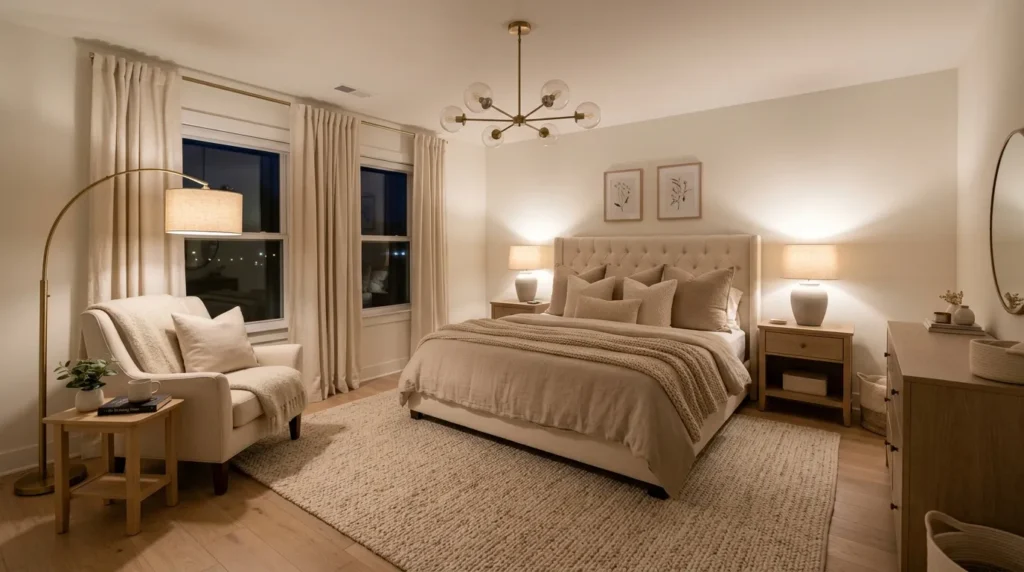
Quick Benefits
- Creates a relaxing atmosphere
- Supports reading and dressing
- Adds depth to the room
- Highlights important furniture
- Reduces dependence on one overhead fixture
Why It Works
Furniture placement and lighting are closely connected. A reading chair without a nearby lamp is not particularly useful, and a dresser placed in a dark corner may not function well as a dressing station.
Layered lighting allows each furniture zone to serve its purpose.
Bedrooms generally benefit from a combination of ambient, task, and accent lighting. The ceiling fixture provides general illumination, bedside lamps support nighttime routines, and floor or table lamps can brighten secondary areas.
Lighting also changes how furniture appears. Warm pools of light can make wood, upholstery, and textiles feel richer and more inviting.
How To Style It
Place bedside lamps at a comfortable height for reading. If nightstand space is limited, consider wall-mounted fixtures.
A floor lamp beside a reading chair can define that zone while providing useful task lighting.
A dresser can benefit from a small lamp if there is sufficient surface space.
Choose fixtures that relate to the bedroom’s overall style. Repeating finishes such as brass, black metal, or brushed nickel can create cohesion.
Use appropriate fixtures and electrical installation practices for your home, especially when adding hardwired lighting.
11. Edit The Layout
Quick Benefits
- Removes unnecessary visual weight
- Improves circulation
- Makes important furniture stand out
- Creates a calmer atmosphere
- Helps the room feel intentionally designed
Why It Works
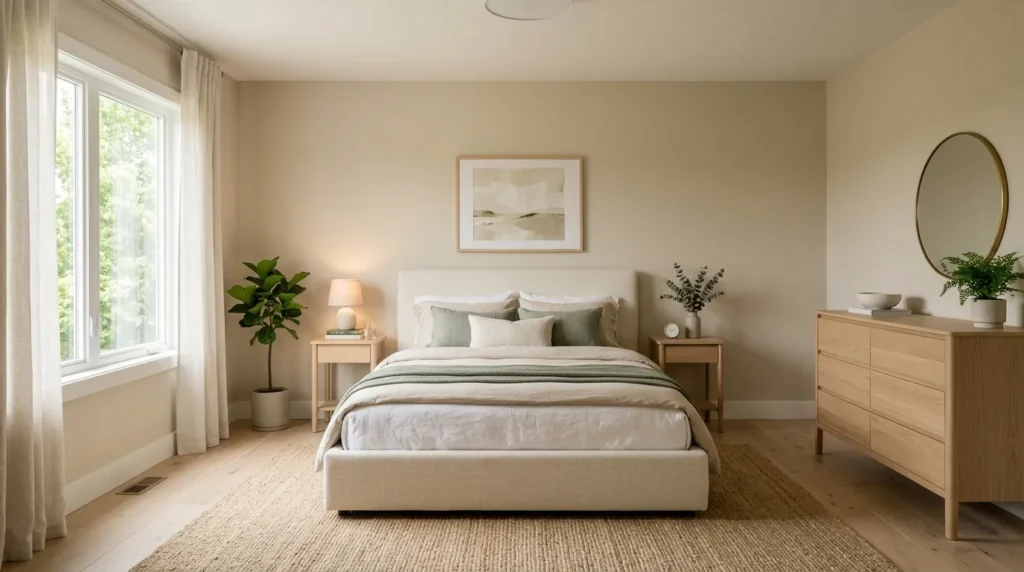
Sometimes the final step in good bedroom design is taking something away.
It is easy to assume an empty corner needs a chair, an empty wall needs a cabinet, or an open surface needs decoration. But adding furniture simply because space is available can work against the sense of calm that a bedroom should provide.
Designers often edit rooms after the major furniture has been placed. They look for pieces that interrupt movement, compete for attention, or do not contribute meaningfully to the room.
A bedroom should feel complete without feeling crowded.
How To Style It
Walk through the room from several directions and pay attention to anything that makes movement awkward.
Remove small furniture pieces that do not have a clear purpose.
Look at the room from the doorway. If your eye immediately jumps between too many objects, simplify the arrangement.
Keep the strongest pieces and let them have some breathing room.
You can also rotate accessories seasonally instead of displaying everything at once. This keeps the bedroom feeling fresh without adding more permanent clutter.
Finally, live with the layout for several days. A bedroom needs to work at 7 a.m. as well as it looks at 7 p.m.
Designer Placement Rules To Remember
Good bedroom design does not require memorizing dozens of measurements. A few principles can guide most furniture decisions.
Start with circulation. A beautiful arrangement that makes everyday movement difficult is not successful design.
Use the bed as the anchor. Once the bed is positioned correctly, the rest of the room becomes easier to organize.
Pay attention to scale. Furniture should fit the physical dimensions and visual proportions of the room.
Create balance. Symmetry is useful, but visual balance can also come from different pieces with similar weight.
Leave breathing room. Empty floor and wall space can make the bedroom feel more sophisticated.
Give furniture a purpose. If you cannot explain why a piece is in the room, consider whether it belongs there.
Work with architecture. Windows, doors, closets, fireplaces, and built-ins should influence the layout.
Think about real life. Make sure drawers open, doors swing freely, pathways remain clear, and frequently used items are accessible.
Common Furniture Placement Mistakes
Even a beautiful bedroom can feel uncomfortable when a few basic layout mistakes occur.
Pushing Everything Against The Walls
This can make a room feel disconnected and may leave an awkward empty area in the center. Some furniture, especially seating, can benefit from being pulled into the room.
Choosing Furniture Before Measuring
A dresser that looks perfect online may be too deep for your bedroom. Always measure the room and check furniture dimensions before purchasing.
Blocking Natural Light
Tall furniture placed directly in front of windows can make a bedroom feel darker and more enclosed.
Ignoring Door Swings
A dresser or nightstand positioned too close to a door can interfere with opening and closing it.
Overcrowding The Bed
A bed surrounded by too many benches, stools, tables, baskets, and accessories can lose its visual impact.
Using Too Many Small Pieces
Several tiny furniture items can sometimes create more visual clutter than one appropriately scaled piece.
Decorating Without Considering Function
A bedroom should support sleep, dressing, storage, and relaxation. Beauty matters, but practicality determines whether the layout remains enjoyable.
How To Rearrange Your Bedroom Without Buying Anything
You can test many designer principles using the furniture you already own.
Start by taking photographs of the room from each corner. Pictures often reveal problems that are difficult to notice while standing inside the space.
Next, remove small accessories from the furniture. This creates a clean starting point.
Identify the bed’s best possible position. Then move the largest pieces first, such as the bed, dresser, and wardrobe.
Once those pieces are placed, add the nightstands and secondary furniture.
Walk through the room several times. Open every drawer and closet door. Sit on the chair. Get into bed. Check whether the room still works when you’re performing normal daily activities.
Only after the functional layout works should you return decorative objects.
This process can save money because it helps you discover what the room actually needs. You may realize that the chair you thought was necessary is making the room feel crowded or that moving the dresser solves a problem you were planning to fix by buying new storage.
Take photographs again after the rearrangement. Compare them with the original images.
Sometimes the improvement becomes much more obvious in a photograph than it does in person.
Choosing Furniture For A Designer-Looking Bedroom
Furniture placement begins with furniture selection. Even the best layout cannot completely compensate for pieces that are dramatically oversized or poorly proportioned.
When choosing a bed, consider both the mattress dimensions and the overall frame dimensions. A bulky frame can occupy substantially more space than the mattress itself.
For nightstands, prioritize enough surface area for practical items without choosing pieces that overwhelm the bed.
Dressers should provide useful storage while leaving enough room for drawers to open comfortably.
Accent chairs should be sized according to the available floor space. In a compact bedroom, a slim upholstered chair may be more useful than a large lounge chair.
Benches should allow enough clearance around the foot of the bed.
If you are furnishing a bedroom from scratch, resist buying every piece from the same collection. Matching furniture can be convenient, but mixing related materials, silhouettes, and finishes often creates a more collected designer appearance.
A consistent color palette can tie different furniture styles together.
Related Articles
- 10 Bedroom Decor Ideas That Make Your Space Feel More Relaxing
- 10 Small Bedroom Ideas That Maximize Every Inch
- 10 Cozy Bedroom Ideas for a Warm and Comfortable Retreat
- 10 Modern Bedroom Ideas With Designer Style
- 10 Bedroom Storage Ideas That Keep Clutter Under Control
Frequently Asked Questions
How should furniture be arranged in a bedroom?
Start with the bed because it is usually the room’s largest and most important piece. Position it where it does not interfere with doors, windows, closets, or major walking routes. Then add nightstands, storage furniture, seating, and lighting according to the available space. The best arrangement balances appearance with comfortable everyday movement.
Should the bed be centered on a wall?
When the room allows it, centering the bed on a strong wall often creates a balanced and polished appearance. However, it is not an absolute rule. Windows, doors, closets, fireplaces, and room dimensions may make another position more practical. Function and circulation should always take priority over symmetry.
How much furniture should a bedroom have?
A bedroom should contain enough furniture to support its daily functions without filling every available space. Start with essential pieces such as the bed, nightstands, and storage. Add seating or additional furniture only when there is enough room to use those pieces comfortably. Leaving some empty space can make the room feel calmer and more sophisticated.
How do designers make a bedroom look expensive?
Designers often focus on proportion, balance, lighting, texture, and restraint rather than simply choosing expensive furniture. A well-positioned bed, coordinated nightstands, layered lighting, quality-looking textiles, an appropriately sized rug, and carefully selected artwork can create a polished appearance. Keeping clutter under control is equally important.
Should bedroom furniture match?
Bedroom furniture does not have to match exactly. In fact, combining pieces with related finishes, proportions, or colors can create a more collected appearance. If you use different furniture styles, repeat one or two elements such as wood tone, metal finish, or upholstery color to connect the pieces visually.
Where should a dresser go in a bedroom?
A dresser should be positioned where its drawers can open fully without blocking doors or walkways. A long empty wall is often a good location. If possible, place a mirror or artwork above it to create a finished furniture arrangement. Avoid positioning a large dresser where it blocks significant natural light.
Is a chair necessary in a bedroom?
No. A chair is useful only when the room has enough space for it to function comfortably. In a large bedroom, a chair can create a relaxing reading area or fill an otherwise empty zone. In a smaller bedroom, adding a chair simply because there is an empty corner may make circulation more difficult.
Conclusion
Decorating a bedroom with designer-inspired furniture placement starts with understanding that layout matters just as much as furniture style. A beautiful bed, dresser, or chair cannot reach its full potential when the pieces compete for space or interrupt the way you move through the room.
Begin with the bed and build outward. Establish clear pathways, create visual balance, respect the room’s proportions, and allow windows and architectural features to influence your decisions. Then add secondary furniture according to genuine needs rather than trying to fill every empty corner.
Lighting, rugs, artwork, mirrors, and textiles can reinforce the arrangement and give the room a finished appearance. But the most important part is still the underlying layout.
If your bedroom currently feels crowded or unfinished, you may not need to buy anything. Try moving the largest pieces first, removing unnecessary furniture, and testing different arrangements with painter’s tape. Give yourself time to experience each layout before deciding which one works best.
The most successful bedroom is one that looks beautiful while supporting real life. When furniture placement, comfort, storage, lighting, and personal style all work together, even an ordinary bedroom can feel thoughtful, balanced, and genuinely inviting.