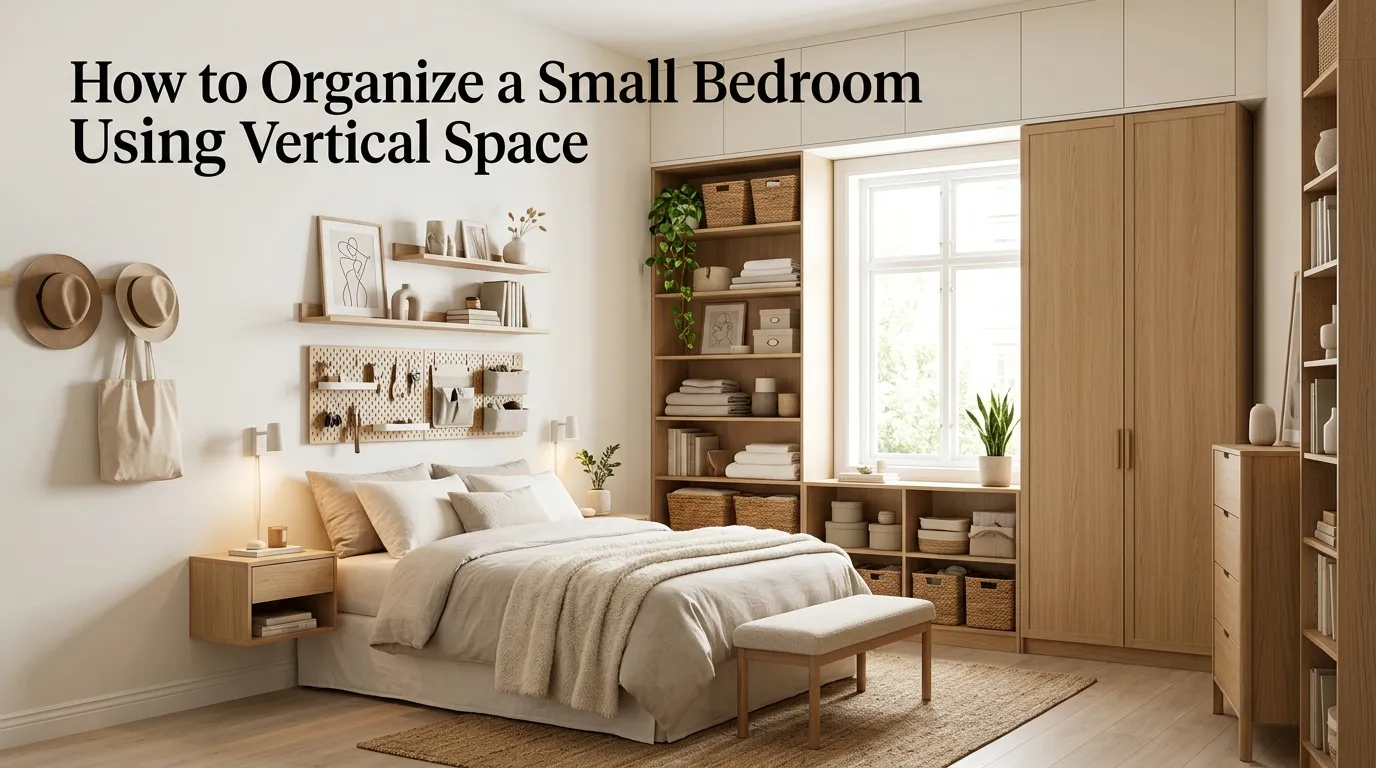
How to Organize a Small Bedroom Using Vertical Space
A small bedroom can become difficult to organize when there simply isn’t enough floor space for another dresser, cabinet, or storage bin. The solution isn’t always getting rid of more belongings. Sometimes, the better approach is to look upward.
Walls, doors, the space above furniture, and even the area near the ceiling can provide valuable storage opportunities without taking up much additional floor area. When vertical space is used thoughtfully, a compact bedroom can feel more functional while keeping everyday items within easy reach.
This approach is particularly helpful for renters, apartment dwellers, dorm rooms, children’s bedrooms, and older homes with small bedrooms. You don’t necessarily need an expensive built-in storage system, either. Floating shelves, pegboards, wall-mounted hooks, over-door organizers, tall bookcases, and narrow cabinets can all make use of otherwise overlooked areas.
I’ve noticed that the biggest improvement often comes from separating frequently used belongings from things that only need occasional access. Everyday items can stay within comfortable reach, while seasonal clothing, luggage, extra bedding, and rarely used accessories can move higher up.
There is also a visual benefit. A tall, narrow storage solution generally uses less floor area than a wide piece of furniture, which can leave more visible floor and walking space.
The ideas below focus on practical ways to organize upward while keeping the bedroom comfortable and visually balanced. Before installing anything, check wall construction, weight limits, and manufacturer instructions, especially for shelves or storage systems holding heavier items.
Table of Contents
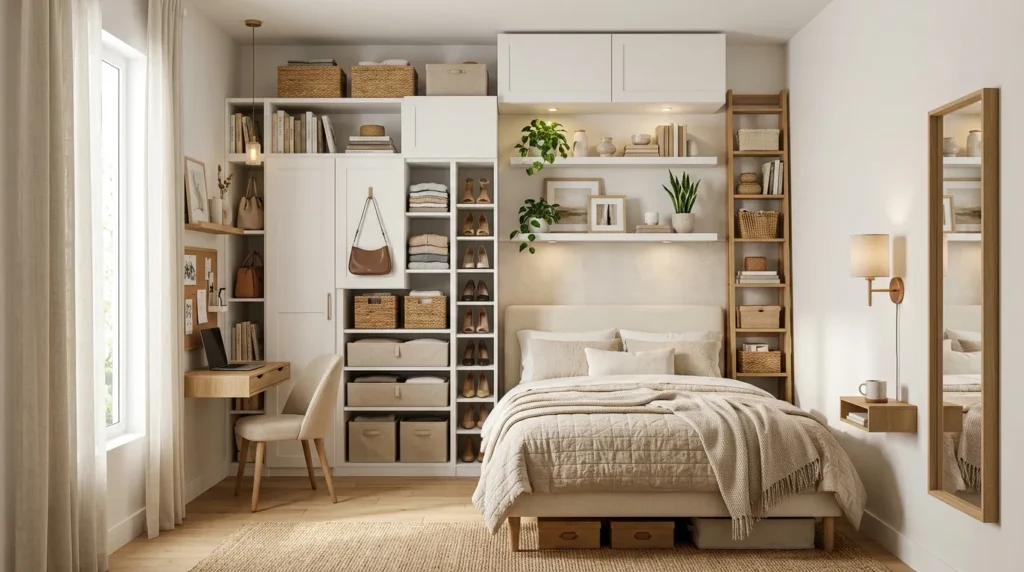
1. Tall Storage Shelves
Use narrow, vertical shelving to gain substantial storage without spreading furniture across the room.
2. Floating Wall Shelves
Turn unused wall areas into practical storage for smaller everyday belongings.
3. Over Door Storage
Use the back of a bedroom door to store accessories without taking up floor space.
4. Vertical Clothing Rails
Create additional hanging space by using the height of the room more efficiently.
5. Wall Mounted Hooks
Keep frequently used clothing, bags, and accessories accessible while clearing surfaces.
6. Tall Narrow Dressers
Choose vertically oriented furniture to maximize drawer storage in a compact footprint.
7. Above Bed Storage
Use the wall above the bed for carefully planned shelving and organization.
8. Pegboard Organization
Create a flexible vertical system for accessories, supplies, and everyday essentials.
9. High Seasonal Storage
Move infrequently used belongings upward to free the most accessible storage areas.
10. Vertical Shoe Storage
Keep footwear organized with tall, narrow solutions instead of bulky floor racks.
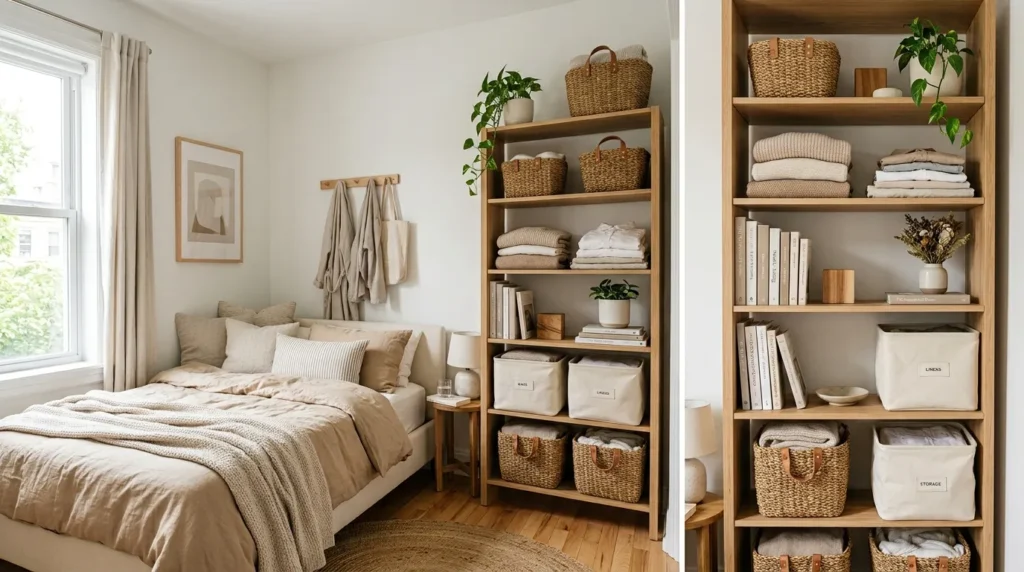
1. Tall Storage Shelves
Quick Benefits
- Uses wall height efficiently
- Provides multiple storage levels
- Works in narrow spaces
- Keeps belongings visible
- Can combine storage and display
Why It Works
A tall shelving unit can provide much more storage than a low cabinet while occupying a relatively small amount of floor area.
This is especially useful when your bedroom has a narrow wall that isn’t wide enough for a traditional dresser. Instead of leaving that area unused, a vertical shelf can turn it into a dedicated storage zone.
Open shelves also make it easier to see what you own. That can be helpful for books, baskets, folded clothing, handbags, accessories, and decorative items.
The main consideration is stability. Tall furniture should be properly secured according to the manufacturer’s instructions, particularly in homes with children or pets.
How To Style It
Choose a shelf that is tall rather than excessively wide.
Use baskets or fabric bins on lower and middle shelves for smaller items that can otherwise look messy.
Keep everyday items at comfortable heights.
Place less frequently accessed belongings on higher shelves.
For a bedroom that needs to feel calm, avoid filling every shelf completely.
Leave some open space and mix functional storage with a few decorative pieces.
2. Floating Wall Shelves
Quick Benefits
- Takes up no floor footprint
- Works above desks and dressers
- Easy to customize
- Creates accessible storage
- Keeps small items organized
Why It Works
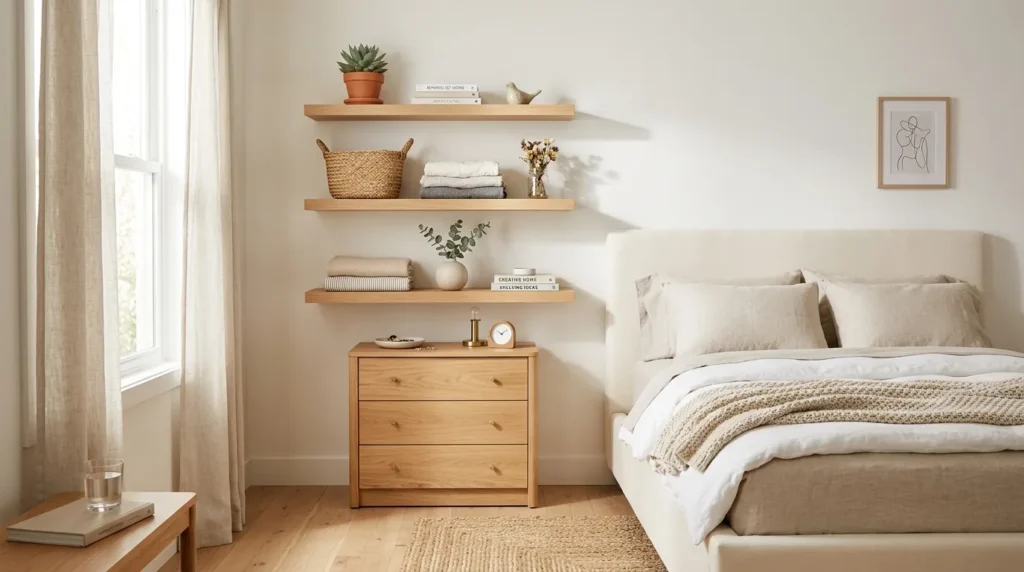
Floating shelves are useful when the bedroom has very little floor space but plenty of unused wall area.
Unlike a freestanding bookcase, a wall-mounted shelf doesn’t consume valuable floor space. This makes it particularly practical above a desk, dresser, nightstand, or empty section of wall.
Several shelves arranged vertically can create a compact storage column.
The important part is not turning every wall into storage. Too many shelves can make a small bedroom feel visually busy.
How To Style It
Install two or three shelves in a vertical arrangement rather than spreading them across an entire wall.
Use small baskets for accessories, folded scarves, or personal items.
Place books vertically and horizontally to create visual variation.
Keep heavier objects on shelves that are properly rated for their weight.
If you’re renting, look for approved removable solutions where appropriate, and always follow the property owner’s rules.
Choose shelf colors that blend with the wall if you want them to visually recede.
3. Over Door Storage
Quick Benefits
- Uses overlooked space
- Requires little floor area
- Great for accessories
- Works in closets and bedrooms
- Keeps small belongings contained
Why It Works
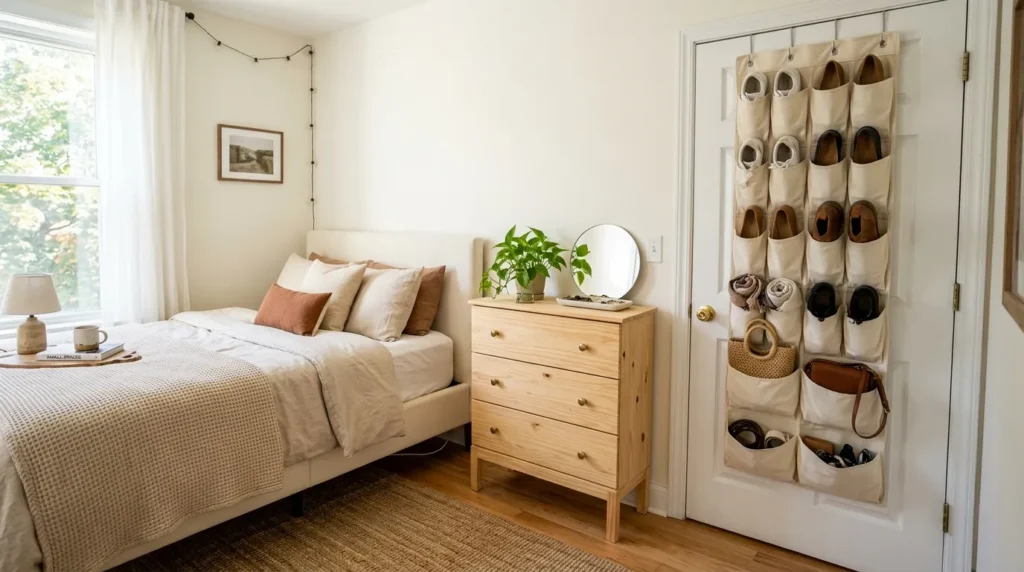
The back of a bedroom door is often completely unused.
An over-door organizer can turn that vertical surface into storage for shoes, handbags, scarves, hair accessories, cleaning supplies, or other lightweight belongings.
It is particularly useful when a closet is small or shared.
The best organizers are designed around the items you actually need to store. A collection of small pockets may be useful for accessories but less helpful for bulky clothing.
How To Style It
Start by deciding what category the organizer will hold.
For example, use one for shoes rather than mixing shoes, jewelry, scarves, and miscellaneous items.
Make sure the organizer does not interfere with the door’s ability to close properly.
Avoid placing excessively heavy items on systems that are not designed to support them.
For a cleaner appearance, choose an organizer in a neutral color that blends with the door.
You can also use the inside of a closet door for less decorative items.
4. Vertical Clothing Rails
Quick Benefits
- Adds hanging capacity
- Uses unused wall height
- Helps organize outfits
- Works well in small closets
- Can display favorite pieces
Why It Works
Traditional clothing rails often use only one horizontal level, leaving a lot of vertical space unused.
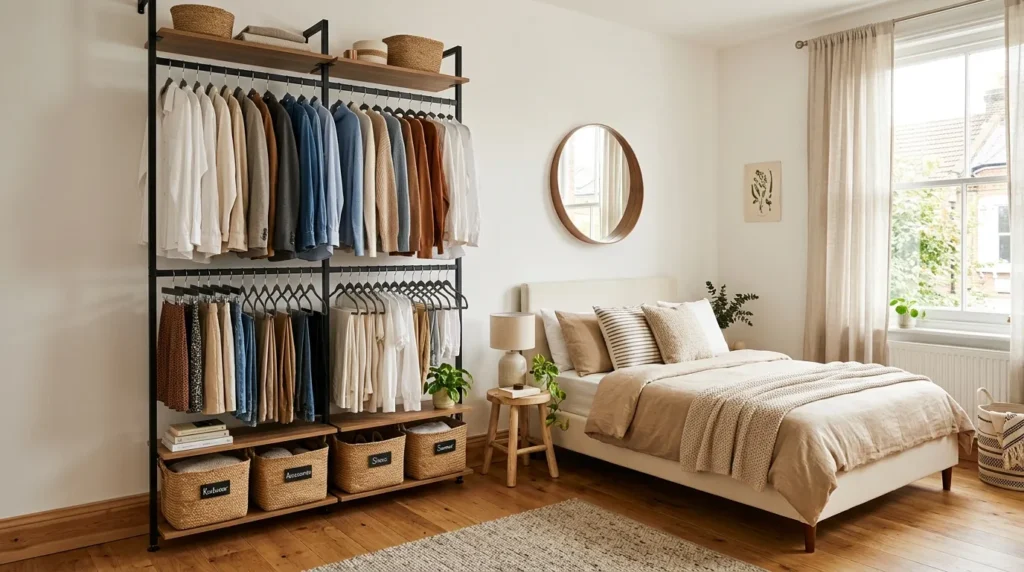
A second hanging level can dramatically increase the amount of clothing that fits in the same footprint.
This works particularly well for shorter garments such as shirts, skirts, and folded-hanging items.
A tall garment rack can also function as an intentional design element in a bedroom, especially when clothing is neatly organized by type or color.
How To Style It
Use a double-hanging system when your wardrobe includes many shorter garments.
Place shirts and jackets on the upper rail and shorter items below when the configuration allows.
Use slim matching hangers to maximize space.
Keep clothing organized by category or color so the rail looks visually calmer.
Store seasonal clothing elsewhere if possible rather than overcrowding the rail.
If you’re installing a wall-mounted rail, make sure it is secured to appropriate wall structure and rated for the intended load.
5. Wall Mounted Hooks
Quick Benefits
- Keeps everyday items accessible
- Clears chairs and floors
- Requires minimal space
- Works for multiple categories
- Easy to rearrange
Why It Works
Hooks are among the simplest vertical storage solutions.
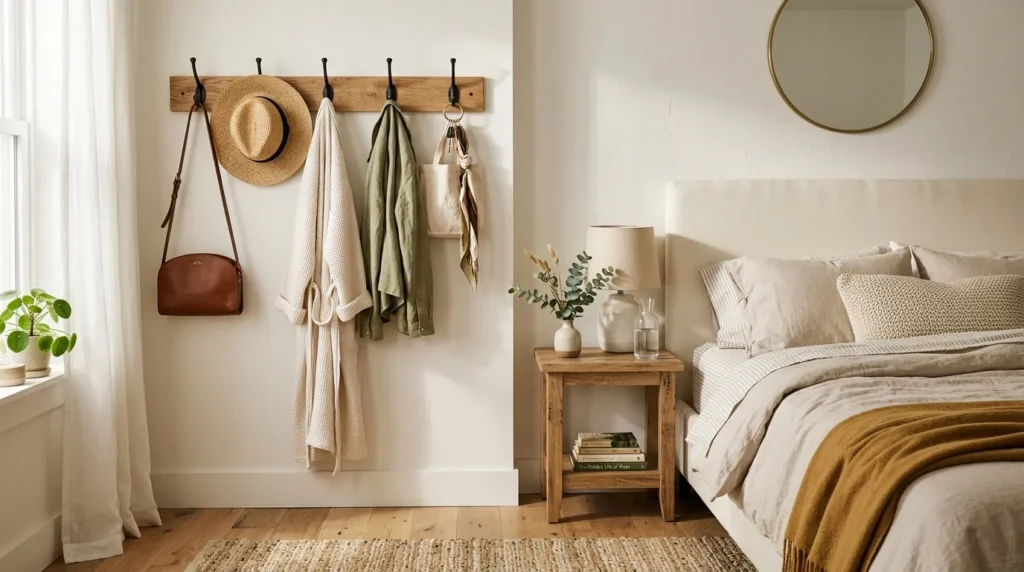
A small row of hooks can hold tomorrow’s outfit, a handbag, hat, robe, or frequently used accessories without requiring another piece of furniture.
The key is limiting what hangs there.
When every available hook becomes overloaded, the system creates visual clutter rather than solving it.
Use hooks for things you regularly reach for rather than long-term storage.
How To Style It
Install hooks at a comfortable height.
Create separate zones for different categories.
For example, use one section for bags and another for robes or jackets.
A narrow wooden rail with several hooks can add warmth to a neutral bedroom.
For a contemporary look, choose simple black or brushed metal hooks.
For children’s rooms, position appropriate hooks at an accessible height while keeping heavier objects securely mounted.
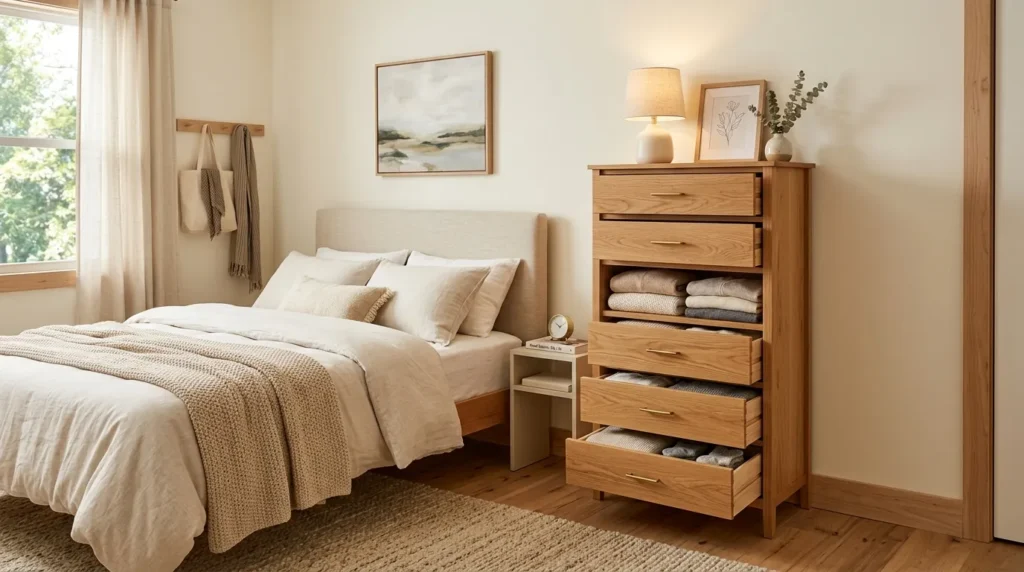
6. Tall Narrow Dressers
Quick Benefits
- Provides substantial drawer storage
- Uses limited floor width
- Works beside beds
- Helps organize clothing categories
- Creates a vertical storage zone
Why It Works
A narrow chest of drawers can be more practical than a wide dresser when floor space is limited.
Instead of spreading storage horizontally, the drawers stack upward.
This makes a tall dresser useful for bedrooms where every inch of floor space matters.
It can also make organizing easier because different clothing categories can have dedicated drawers.
Before purchasing one, measure the available width, depth, and ceiling clearance.
How To Style It
Choose a dresser with enough depth for your clothing without blocking walking paths.
Use upper drawers for smaller or lighter items and lower drawers for bulkier clothing when convenient.
Avoid placing tall furniture where it blocks windows or important light sources.
Use the top surface sparingly.
A small lamp, mirror, tray, or plant may be enough.
If the dresser is particularly tall, follow the manufacturer’s wall-anchoring recommendations.
7. Above Bed Storage
Quick Benefits
- Uses otherwise empty wall space
- Creates a natural storage zone
- Can display books and decor
- Keeps floor area clear
- Works in compact bedrooms
Why It Works
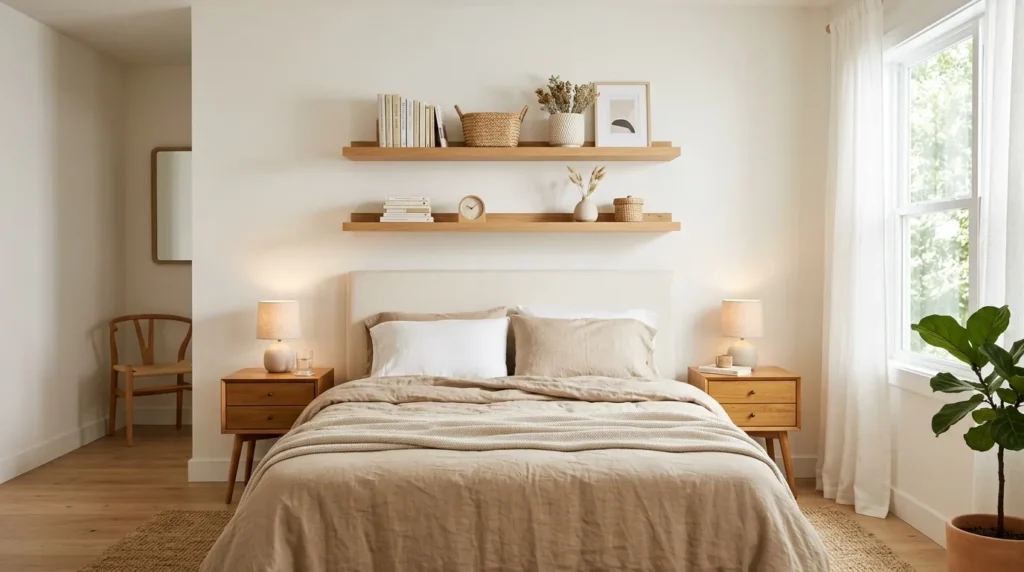
The wall above the bed is often one of the largest unused vertical surfaces in a small bedroom.
With careful planning, it can become a useful storage or display area.
However, safety matters more here than in many other parts of the bedroom. Heavy or poorly secured objects positioned above a bed can create unnecessary risk.
For that reason, lightweight decorative items or properly installed storage designed for the purpose are preferable.
How To Style It
Consider shallow shelves for books and small decorative pieces.
Keep shelves appropriately positioned so they don’t interfere with sitting up in bed.
Use secure mounting hardware suitable for the wall type and load.
For a softer appearance, choose shelves in natural wood or a color similar to the wall.
If you’re uncomfortable installing storage above the bed, use the adjacent wall instead.
The goal is additional organization without compromising comfort or safety.
8. Pegboard Organization
Quick Benefits
- Highly customizable
- Works for small accessories
- Makes supplies visible
- Can change as needs change
- Uses wall space efficiently
Why It Works
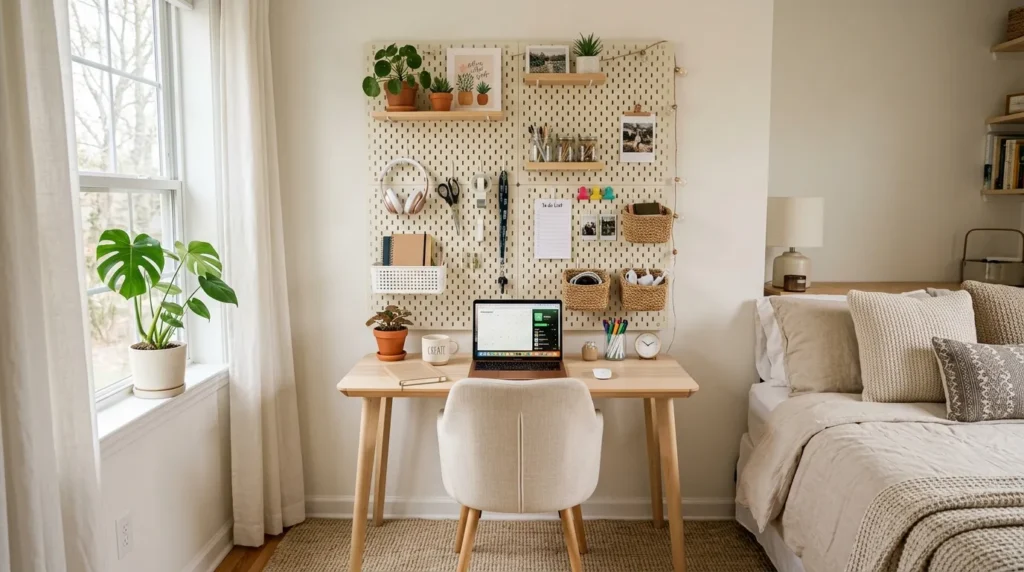
A pegboard turns a section of wall into an adjustable storage system.
Hooks, shelves, small containers, and holders can be moved as your needs change.
This makes pegboards especially useful for bedrooms that double as workspaces, craft areas, dressing rooms, or study spaces.
Unlike fixed shelving, the arrangement can evolve without requiring an entirely new storage system.
How To Style It
Create zones instead of hanging items randomly.
For a dressing area, use hooks for bags and accessories.
For a study corner, add containers for stationery and small supplies.
For a craft area, organize tools by frequency of use.
Choose a board color that works with the room’s palette.
Keep the most frequently used items in the easiest-to-reach locations.
9. High Seasonal Storage
Quick Benefits
- Frees accessible storage
- Keeps seasonal items contained
- Uses upper areas efficiently
- Reduces daily clutter
- Works well for small closets
Why It Works
Not everything needs to be stored at eye level.
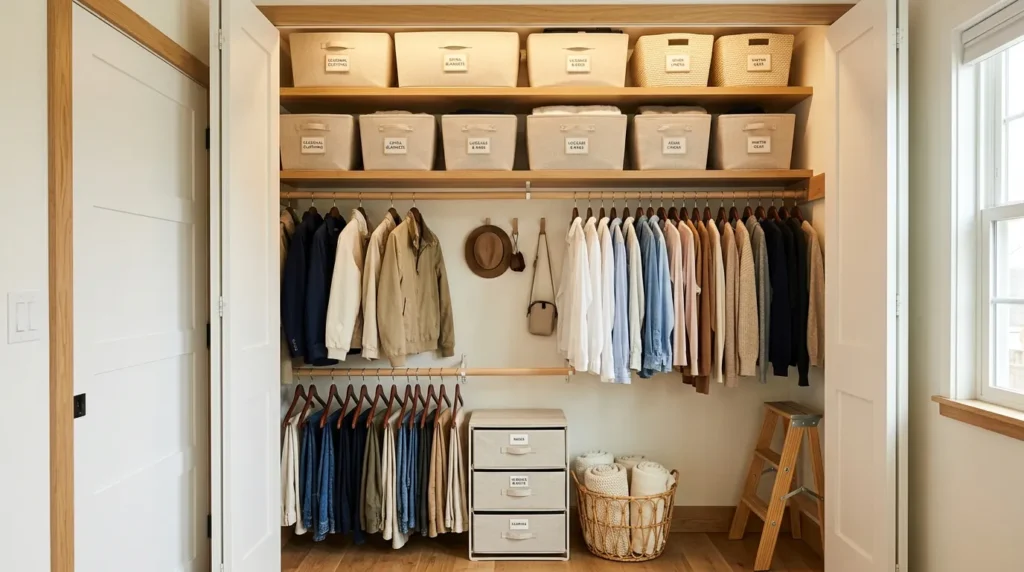
Winter coats, holiday decorations, extra blankets, luggage, and occasional-use items can often be moved into higher storage areas.
This leaves the easiest-to-reach spaces available for things you use every day.
The trick is creating a system so that high storage doesn’t become a place where belongings disappear.
How To Style It
Use clearly labeled containers for items stored above eye level.
Choose uniform bins if the area is visible.
Store lighter items higher and heavier objects lower where practical.
Keep a simple inventory if you have many seasonal containers.
Avoid placing heavy items somewhere that requires unstable furniture or unsafe climbing to reach them.
A properly installed high shelf or closet storage system is preferable to improvising.
10. Vertical Shoe Storage
Quick Benefits
- Keeps shoes off the floor
- Uses narrow spaces
- Makes footwear easier to find
- Works inside closets
- Frees valuable floor area
Why It Works
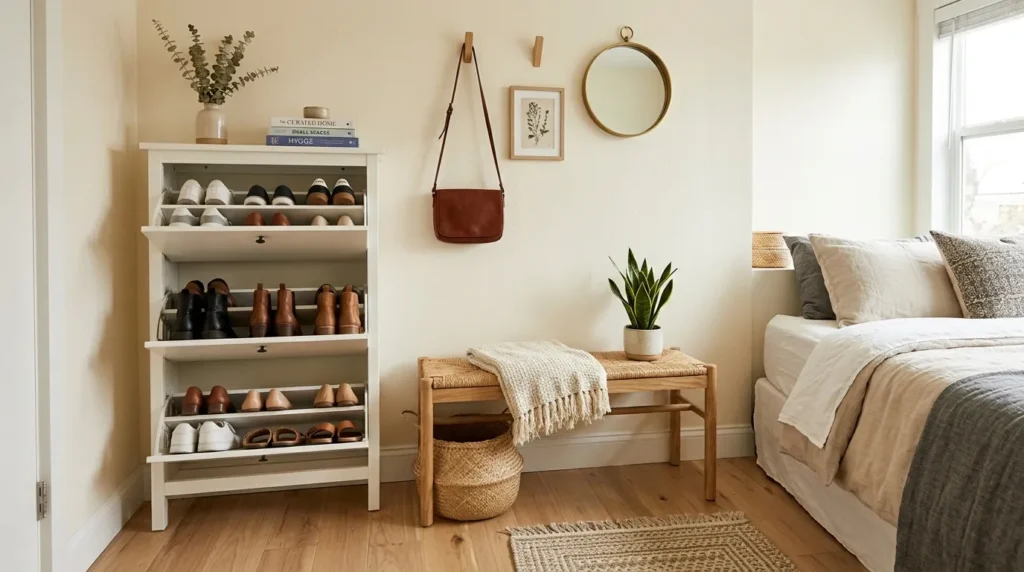
Shoes can consume surprising amounts of floor space when they are stored in piles or scattered near the bedroom entrance.
A vertical shoe rack or narrow shoe cabinet can move the collection upward and create a cleaner floor.
Tall storage is particularly useful for smaller bedrooms because it uses wall height instead of expanding outward.
How To Style It
Choose a shoe organizer based on the number and types of shoes you own.
Open shelving makes everyday pairs easy to access.
A closed cabinet creates a cleaner appearance if the storage is located in the bedroom itself.
Place frequently worn shoes at comfortable heights and seasonal footwear higher up.
Avoid overcrowding. If the storage system is full, remove unused or rarely worn pairs before adding another organizer.
How To Find Vertical Storage Opportunities
Before buying anything, walk around your bedroom with a measuring tape.
Look at:
- The wall above your dresser
- The area behind the bedroom door
- Empty wall corners
- Space above your desk
- The top section of your closet
- The wall beside your wardrobe
- Space above low furniture
- Narrow gaps beside existing furniture
- The wall above a nightstand
Then measure the height, width, and depth available.
This simple exercise can reveal storage opportunities you may not have noticed.
Think about accessibility as well.
The highest shelves are useful for things you rarely need. Everyday items should stay within easy reach.
A successful vertical storage system is not simply about using every inch of wall. It is about assigning each height level a purpose.
How To Organize A Small Bedroom By Frequency
A useful system is to divide belongings into three groups.
Daily Use
Keep these at waist, chest, or eye level.
Examples include everyday clothing, handbags, frequently used books, and regular accessories.
Weekly Use
These can go on higher shelves or inside less accessible drawers.
Examples include occasional shoes, extra linens, and specialty clothing.
Seasonal Use
These belong in the highest or least accessible areas.
Examples include holiday items, winter accessories, luggage, and seasonal bedding.
This simple system makes vertical storage much easier to maintain.
How To Make Vertical Storage Look Attractive
Storage doesn’t have to look purely functional.
Use matching baskets or bins when possible.
Repeat materials such as natural wood, woven fibers, or matte metal.
Keep the color palette coordinated with the bedroom.
For open shelving, mix practical storage with a few decorative objects.
Avoid filling every shelf to its maximum capacity.
Negative space helps a small bedroom feel calmer.
If you are using several vertical storage pieces, align their heights or finishes where possible so the room feels intentional rather than pieced together.
Common Small Bedroom Organization Mistakes
Using Only Floor Storage
Large bins and wide cabinets can quickly consume the walking space you are trying to preserve.
Putting Everything Up High
Vertical organization doesn’t mean every item belongs near the ceiling. Daily essentials should remain easy to reach.
Ignoring Weight Limits
Shelves and wall-mounted systems must be installed according to their specifications.
Overloading Open Shelves
Too many visible items can create visual clutter.
Forgetting Door Clearance
Over-door organizers and furniture should not interfere with doors, drawers, windows, or walking paths.
Buying Before Measuring
A tall organizer can still be the wrong choice if it is too deep or wide for the available space.
Treating Vertical Storage As Permanent
Your storage system should be adjustable when possible. Your needs may change over time.
Frequently Asked Questions
How can I organize a small bedroom without adding more floor furniture?
Use the walls, doors, closet height, and areas above existing furniture. Floating shelves, wall hooks, pegboards, over-door organizers, and tall narrow storage can provide additional capacity without significantly reducing walking space. Start by identifying unused vertical areas before purchasing anything.
What should I store on high shelves?
High shelves are best for items you don’t need frequently, such as seasonal clothing, extra bedding, luggage, holiday decorations, or occasional-use accessories. Use labeled containers so items remain easy to identify. Avoid storing heavy objects in locations that are difficult or unsafe to access.
Is vertical storage good for a very small bedroom?
Yes. Tall, narrow storage generally uses less floor area than wide furniture and can provide substantial capacity. It works particularly well when a bedroom has high ceilings or unused wall space. Choose appropriately scaled furniture so the room doesn’t feel visually crowded.
How do I make vertical storage look less cluttered?
Use coordinated baskets, bins, and containers for smaller belongings. Group similar items together and leave some open space between objects. For open shelves, combine functional storage with a limited number of decorative pieces. Keeping colors and materials consistent can also create a calmer appearance.
What can I store behind my bedroom door?
The back of a bedroom door can hold lightweight accessories such as shoes, scarves, hats, handbags, robes, and small personal items. Use an organizer appropriate for the door and intended load, and make sure it doesn’t prevent the door from closing properly.
How do I use the space above my bed?
You can use the wall above the bed for carefully installed shallow shelving, artwork, or other appropriate storage. Safety is especially important in this location. Avoid unsecured heavy objects and follow installation instructions for any wall-mounted system. If you’re uncertain, use a nearby wall instead.
How do I organize a small bedroom closet vertically?
Use the full height of the closet with appropriate shelving, double hanging rails, stackable storage, and labeled bins. Keep frequently worn clothing within easy reach and move seasonal items higher. Slim matching hangers can also help maximize hanging capacity without increasing the closet’s footprint.
Conclusion
Organizing a small bedroom becomes much easier when you stop looking only at the floor.
The walls, doors, closet height, and space above existing furniture can all become useful storage areas. Tall shelving, floating shelves, hooks, pegboards, vertical shoe organizers, and narrow dressers can add meaningful storage without taking up the same floor area as larger horizontal furniture.
The most important step is to organize by frequency. Keep everyday belongings within easy reach, place occasional items higher, and reserve the highest areas for seasonal storage.
At the same time, don’t feel pressured to fill every available wall. A bedroom still needs breathing room. Leaving some empty wall and shelf space can make the room feel calmer and more comfortable.
Start with one problem area, such as an overflowing closet or shoes scattered across the floor. Choose one vertical solution, test how it works, and build from there.
With thoughtful planning, even a very small bedroom can become easier to use, easier to maintain, and much more comfortable without expanding the room itself.