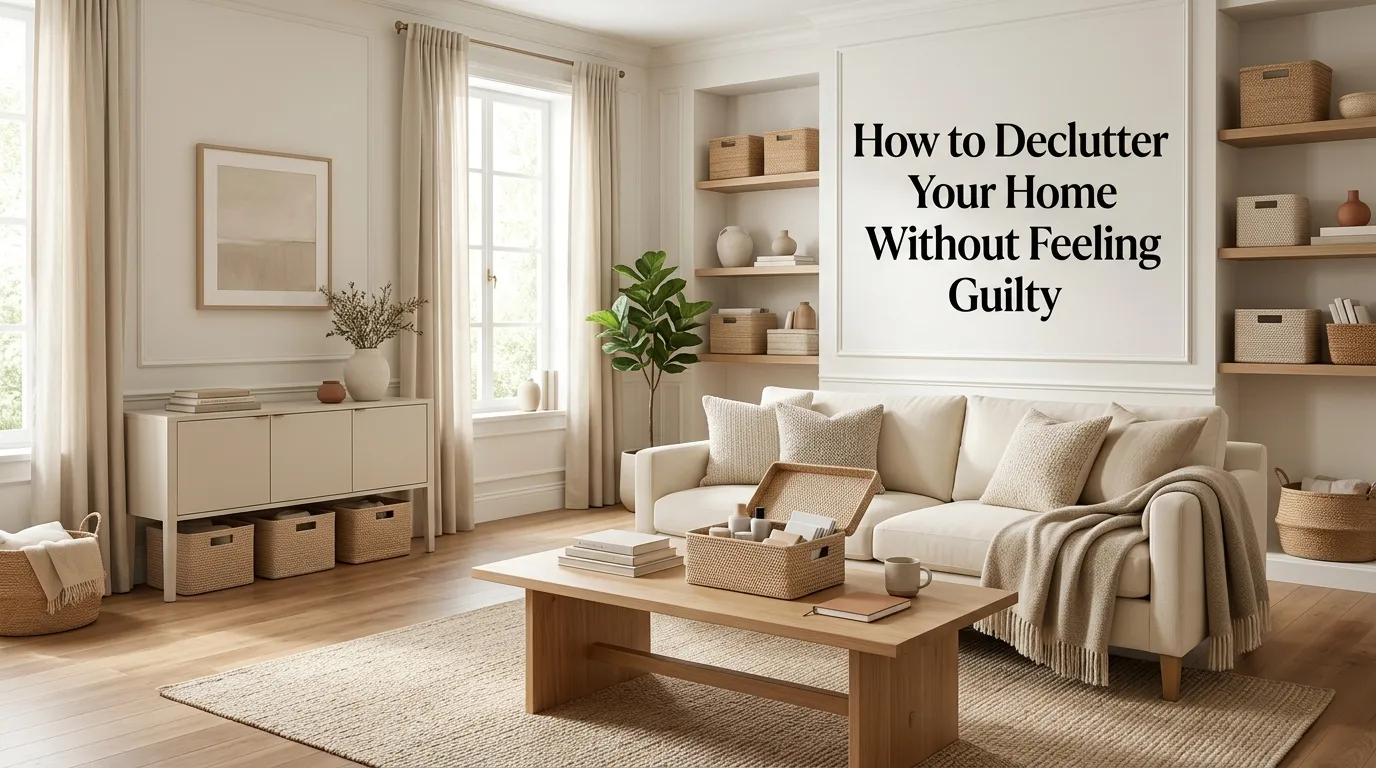
How to Declutter Your Home Without Feeling Guilty
Decluttering sounds simple until you pick up an object and suddenly remember where it came from, who gave it to you, how much it cost, or how useful it might become someday.
That emotional side of clutter is often harder than the physical work.
A kitchen drawer filled with unused gadgets is easy to understand. A box of childhood keepsakes, clothes from a different stage of life, or gifts from people you love can feel much more complicated. That’s why a home can remain crowded even when you genuinely want a simpler space.
The good news is that decluttering doesn’t require you to become extremely minimalist or throw away everything that isn’t used every week. A comfortable home can contain meaningful possessions. The goal is to create enough space for the things you actually use, enjoy, and value.
In my experience, guilt becomes easier to manage when decluttering is treated as a decision-making process rather than a test of how much you can get rid of. You can appreciate an item and still decide that it no longer belongs in your home. You can also keep something because it has genuine meaning, even if it isn’t practical.
A useful approach is to slow down, work in small areas, and separate sentimental decisions from everyday clutter. Instead of attacking the entire house in one weekend, start with an easy drawer, shelf, or category.
These ideas can help you declutter with more confidence while keeping the process realistic, respectful, and emotionally manageable.
Table of Contents

1. Start With Easy Wins
Begin with low-emotion clutter to build momentum without making difficult decisions immediately.
2. Separate Guilt From Value
Learn to distinguish genuine usefulness and meaning from the feeling that you are obligated to keep something.
3. Declutter One Zone
Work within a clearly defined space so the process feels manageable and measurable.
4. Use a Keep Test
Evaluate possessions using practical questions instead of automatic guilt.
5. Create a Memory Box
Give sentimental items a designated boundary instead of allowing memories to spread throughout the home.
6. Release Gift Guilt
Reframe unwanted gifts as thoughtful gestures that don’t require permanent storage.
7. Handle Expensive Items
Make decisions based on present usefulness rather than the original purchase price.
8. Set a Maybe Box
Give uncertain items a temporary home so difficult decisions don’t stop your progress.
9. Make Decluttering Easier
Create simple systems that reduce the amount of clutter returning to your home.
10. Celebrate the Space
Focus on what your home gains rather than everything you let go.
1. Start With Easy Wins

Quick Benefits
- Builds confidence
- Reduces visible clutter
- Creates quick progress
- Avoids emotional decisions
- Makes larger projects easier
Why It Works
Decluttering doesn’t have to begin with the hardest room or most sentimental belongings.
Starting with easy wins allows you to experience progress without immediately confronting emotional attachments.
Look for things that require little thought: expired products, empty containers, broken items, duplicate kitchen tools, old paperwork, worn-out accessories, or objects you already know you don’t use.
The visual difference can be surprisingly motivating.
One simple trick I always suggest is choosing an area you see every day. A kitchen counter, bathroom drawer, entryway basket, or bedside table can provide an immediate sense of improvement.
Once your brain gets used to making small decisions, larger categories often feel less intimidating.
How To Style It
Choose one small area and set a short working period.
Remove everything from the space and sort items into three basic groups:
- Keep
- Remove
- Decide later
Don’t start by emptying an entire room.
A drawer or shelf is enough.
Dispose of obvious trash and separate items that can be donated, recycled, repaired, or passed along.
Return only the things you genuinely want in that space.
When finished, stop.
You don’t have to continue until the entire house is organized. The purpose of an easy win is to create momentum without creating exhaustion.
2. Separate Guilt From Value

Quick Benefits
- Makes emotional decisions easier
- Reduces unnecessary attachment
- Clarifies why you keep things
- Helps distinguish memories from objects
- Creates a calmer decision process
Why It Works
Guilt can make an item feel more valuable than it actually is.
You might keep a sweater because someone important gave it to you, even though you never wear it. You might keep an appliance because it was expensive, even though it has been sitting unused for years.
The feeling is real, but it doesn’t automatically mean the item deserves space in your home.
Ask yourself whether you are keeping the object because you genuinely enjoy or use it, or because you feel responsible for keeping it.
Those are very different reasons.
An object can represent love, gratitude, history, or an important moment without needing to remain physically present forever.
How To Style It
When you encounter an emotional item, pause before making a decision.
Ask:
- Do I actually use this?
- Do I enjoy seeing it?
- Does it represent a meaningful memory?
- Would I choose to keep it if nobody knew?
- Am I keeping it from love or obligation?
Don’t force an immediate decision.
If an item represents a relationship or memory, consider whether you can preserve the memory in another way.
Take a photograph.
Write down the story behind it.
Keep one representative item rather than an entire collection.
The goal isn’t to remove meaning from your home.
It is to make room for meaningful possessions without allowing guilt to make every object permanent.
3. Declutter One Zone

Quick Benefits
- Prevents overwhelm
- Makes progress visible
- Reduces mess during the process
- Creates clear boundaries
- Makes the project easier to finish
Why It Works
One of the easiest ways to become overwhelmed is to start decluttering everywhere at once.
You pull things from the bedroom, kitchen, closets, and garage, then suddenly have piles covering the house.
Instead, create a physical boundary.
A drawer is one zone.
A bathroom cabinet is one zone.
One closet shelf is one zone.
This approach gives you a clear beginning and a clear ending.
It also creates a satisfying visual transformation.
How To Style It
Choose one area based on how frequently you use it.
Empty the zone completely.
Clean the surface.
Group similar objects together.
Then make decisions category by category.
For a kitchen cabinet, group mugs, glasses, containers, and appliances separately.
For a closet shelf, group scarves, bags, or folded clothing.
This makes duplicates easier to notice.
Return the items you use and enjoy.
If something belongs somewhere else, move it to its proper location instead of creating another temporary pile.
Finish the zone before moving to another one.
That simple rule keeps the project contained.
4. Use a Keep Test

Quick Benefits
- Makes decisions more objective
- Reduces overthinking
- Works across different rooms
- Helps identify duplicates
- Encourages intentional ownership
Why It Works
When every item has an emotional story, decluttering can feel impossible.
A simple decision framework gives you something practical to rely on.
A useful question is:
Would I choose to bring this item into my home today?
If the answer is no, explore why.
Maybe the item is useful but rarely needed.
Maybe you have a better version.
Maybe it belongs to an earlier stage of your life.
Maybe you don’t like it anymore.
There is no universal rule requiring every possession to pass the same test. The purpose is simply to make the decision conscious.
How To Style It
Pick up one item at a time.
Ask:
- Do I use it?
- Do I like it?
- Does it have meaningful sentimental value?
- Do I have another item that performs the same job?
- Does keeping it create more work or storage than its value justifies?
If it clearly earns its place, keep it.
If you’re unsure, use your temporary decision box.
If it no longer serves a purpose, place it in the appropriate donation, recycling, or disposal category.
Avoid creating complicated scoring systems.
The simpler the decision process, the easier it is to maintain.
5. Create a Memory Box

Quick Benefits
- Protects meaningful keepsakes
- Creates a physical boundary
- Prevents sentimental clutter
- Makes memories easier to organize
- Allows thoughtful preservation
Why It Works
Sentimental belongings can be among the most difficult things to declutter because the object often represents something much larger.
The solution doesn’t have to be getting rid of everything.
A memory box creates a limit.
Instead of allowing photographs, cards, childhood objects, letters, souvenirs, and small keepsakes to occupy multiple drawers, closets, and shelves, give them a designated home.
The physical boundary makes decisions easier.
If the box is full, you have a natural reason to review its contents.
How To Style It
Choose one durable container for meaningful keepsakes.
You can create separate boxes for different family members, life stages, or categories if that makes sense for your household.
Label the box clearly.
When deciding what belongs inside, choose items that genuinely represent a memory.
You don’t need five nearly identical souvenirs.
Choose the one that tells the story best.
Photograph larger objects that are difficult to store.
For children’s artwork, consider keeping a small selection while photographing the rest.
Store memory boxes somewhere dry and easy to access.
The goal is preservation with boundaries.
6. Release Gift Guilt

Quick Benefits
- Makes unwanted gifts easier to handle
- Reduces emotional clutter
- Creates more useful spaces
- Separates gratitude from ownership
- Helps prevent future accumulation
Why It Works
Gifts can be emotionally complicated.
You may think, “Someone chose this for me, so getting rid of it feels disrespectful.”
But gratitude and ownership are separate things.
A gift represents a gesture.
You can appreciate the person, the thought, and the moment without keeping the physical object forever.
This can be especially important when your home contains many items you don’t like or use simply because they were gifts.
Keeping something out of guilt doesn’t make the original gesture more meaningful.
How To Style It
When handling a gift you don’t use, acknowledge the reason it was meaningful.
Then ask whether it still serves a purpose in your home.
If not, choose an appropriate next step.
Donate it.
Pass it to someone who will enjoy it.
Recycle it if necessary.
Or use it until it reaches the end of its useful life.
If you receive a gift that isn’t suitable for your home, avoid creating a permanent storage category for future unwanted items.
A gracious thank-you can remain exactly that: gratitude.
Your home doesn’t have to become a museum of every thoughtful gesture you’ve received.
7. Handle Expensive Items

Quick Benefits
- Reduces financial guilt
- Prevents unused possessions from taking over
- Encourages realistic decisions
- Makes storage more intentional
- Helps identify sunk costs
Why It Works
Expensive belongings can be difficult to release because the purchase price remains emotionally attached to the object.
But the money has already been spent.
Keeping an unused item doesn’t recover the original cost.
Instead, it continues to occupy physical space and may create maintenance, storage, or visual clutter.
Ask yourself what the item is worth to your life today, rather than what you paid for it.
A high-priced appliance that hasn’t been used in years may have less practical value than a simple everyday tool you use constantly.
How To Style It
When you find an expensive item you rarely use, ask:
- Have I used this recently?
- Do I realistically expect to use it?
- Would I buy it again today?
- Is it easy to replace if I eventually need one?
- Could someone else benefit from it now?
If selling is worthwhile, research a realistic current resale value.
Don’t keep an item indefinitely because you’re waiting for a perfect selling opportunity.
Set a reasonable deadline.
If it doesn’t sell, consider another useful destination.
Decluttering isn’t about ignoring money.
It’s about recognizing that unused possessions don’t become more valuable simply because they were expensive.
8. Set a Maybe Box

Quick Benefits
- Reduces decision pressure
- Prevents unnecessary discarding
- Helps identify genuine attachment
- Keeps uncertain items contained
- Makes decluttering less stressful
Why It Works
Not every decision has to happen immediately.
Sometimes you genuinely don’t know whether you’ll miss an item.
A temporary “maybe box” gives you space to find out.
The important part is that the box has boundaries and a review date.
Without a time limit, it simply becomes another form of storage.
The box works because it separates the physical act of removing something from the emotional act of permanently letting it go.
How To Style It
Choose one container for uncertain items.
Label it with the date you created it.
Place questionable items inside.
Don’t keep opening the box every few days.
After a reasonable period, review it.
If you forgot about most of the items, that information matters.
If you repeatedly needed or thought about something, consider returning it to your home.
For sentimental belongings, give yourself more flexibility.
For ordinary household clutter, a shorter review period can work.
The goal is not to trick yourself into getting rid of things.
It’s to give yourself enough distance to make clearer decisions.
9. Make Decluttering Easier

Quick Benefits
- Prevents clutter from returning
- Makes maintenance simpler
- Reduces future decision-making
- Creates sustainable habits
- Protects newly cleared spaces
Why It Works
Decluttering isn’t finished when the bags leave the house.
The real improvement happens when your home becomes easier to maintain.
If every empty shelf immediately fills with new purchases, the original work doesn’t last.
You don’t need strict shopping rules.
A few intentional habits can make a noticeable difference.
Pay attention to what enters your home.
Also notice which categories repeatedly become cluttered.
That tells you where your systems need improvement.
How To Style It
Create simple boundaries.
For example:
- One basket for incoming mail
- One drawer for charging accessories
- One container for cleaning supplies
- One shelf for travel items
- One designated place for reusable bags
When a category repeatedly overflows, review it.
Avoid buying storage containers before decluttering.
Storage can organize belongings, but it doesn’t solve excess.
After clearing an area, make the easiest choice the organized choice.
If shoes naturally pile near the door, place a shoe rack there.
If paperwork accumulates on the kitchen counter, create a dedicated paper tray nearby.
Good organization works with your habits rather than against them.
10. Celebrate the Space

Quick Benefits
- Shifts focus toward positive results
- Creates motivation
- Helps emotional closure
- Makes the home feel intentional
- Encourages sustainable habits
Why It Works
Decluttering conversations often focus on what leaves the house.
But the more important question is what remains.
You gain an easier-to-clean kitchen.
You gain a clearer bedroom.
You gain room to display things you genuinely love.
You gain fewer objects demanding your attention.
This change in perspective can make decluttering feel less like deprivation and more like editing your surroundings.
Instead of counting how many bags you removed, notice what the room feels like afterward.
How To Style It
After completing an area, pause before immediately starting another.
Clean the newly cleared surface.
Put back only the items you intentionally chose.
Add one thing you genuinely enjoy if the space benefits from it.
Maybe that’s a favorite vase, framed photograph, plant, or book.
Then use the space.
Sit in the chair that was previously covered with clothing.
Cook in the kitchen without moving objects first.
Open the closet and appreciate the extra breathing room.
The point of decluttering isn’t an empty house.
It’s a home that supports the way you want to live.
How To Declutter Without Feeling Like You’re Throwing Memories Away
One of the most important distinctions in decluttering is recognizing that memories and objects are not the same thing.
A photograph can preserve the appearance of an item.
A written note can preserve its story.
A conversation can preserve a memory.
Sometimes the physical object genuinely matters, and keeping it is completely reasonable.
The goal isn’t to force yourself to become detached.
Instead, decide which physical objects carry the most meaning.
If you have ten souvenirs from one trip, perhaps one or two represent the experience well.
If you have dozens of childhood drawings, a small selection can preserve that stage of life.
If an inherited object has genuine significance and you have space for it, keeping it can be part of your home’s story.
Decluttering works best when you distinguish meaningful abundance from accidental accumulation.
A Simple Decluttering Checklist
When you don’t know where to begin, use this sequence:
Step 1: Choose One Small Area
Pick one drawer, shelf, cabinet, or surface.
Step 2: Remove Everything
Create a clean starting point.
Step 3: Group Similar Items
Duplicates become easier to spot.
Step 4: Identify Obvious Clutter
Remove broken, expired, empty, or unwanted items.
Step 5: Ask the Keep Questions
Consider usefulness, enjoyment, meaning, and duplication.
Step 6: Create a Maybe Box
Give uncertain items a temporary boundary.
Step 7: Return the Keepers
Put everything back intentionally.
Step 8: Remove the Exit Items
Don’t let donation or recycling piles become permanent clutter.
Step 9: Enjoy the Result
Spend a moment noticing the difference.
Step 10: Repeat Later
One completed zone is meaningful progress.
What To Declutter First
If your home feels overwhelming, start with categories that are usually easier to evaluate.
Consider:
- Expired food
- Empty containers
- Broken household items
- Duplicate kitchen tools
- Worn-out towels
- Old cosmetics
- Unused cords
- Outdated paperwork
- Clothes that no longer fit your lifestyle
- Damaged decor
- Duplicate cleaning supplies
- Items you already planned to replace
Leave highly sentimental categories for later.
There is no reason to begin your decluttering journey with family heirlooms or boxes of childhood memories.
Build confidence first.
What Not To Declutter in a Rush
Some possessions deserve more thoughtful consideration.
These can include:
- Family photographs
- Letters
- Inherited belongings
- Legal documents
- Important financial records
- Sentimental children’s items
- Irreplaceable memorabilia
- Specialized equipment
- Items with significant family history
When you’re tired, emotional, or under pressure, postpone difficult decisions.
Decluttering doesn’t require speed.
A slower decision that feels right is more useful than a fast decision you regret.
FAQ
How do I declutter without feeling guilty?
Separate the emotional meaning of an item from the physical object itself. Ask whether you are keeping something because you genuinely value it or because you feel obligated. For sentimental belongings, consider keeping a small representative collection or preserving memories through photographs and written stories.
Why do I feel guilty when getting rid of things?
Objects can represent money, relationships, memories, opportunities, or earlier versions of ourselves. Removing the object can therefore feel emotionally larger than the physical act. Recognizing that guilt doesn’t automatically indicate that something deserves to stay can make the decision easier.
What should I declutter first?
Start with obvious, low-emotion clutter such as expired products, broken items, duplicates, empty containers, outdated paperwork, and things you already know you don’t use. Easy wins build confidence before you move into more emotionally complicated categories.
How do I declutter sentimental items?
Create a specific boundary for sentimental belongings, such as one memory box or designated shelf. Choose the items that best represent the memory instead of automatically keeping every related object. Photograph large or difficult-to-store pieces when the memory matters more than the physical object.
Should I keep gifts I don’t use?
You can appreciate a gift without keeping it forever. Consider whether you genuinely use or enjoy the item. If you don’t, passing it along to someone who can use it can give the object another useful life while allowing you to keep the gratitude associated with the original gesture.
How do I declutter when my whole house feels overwhelming?
Don’t start with the whole house. Choose one small zone and finish it completely. A drawer, countertop, bathroom cabinet, or shelf provides a manageable starting point. Once you see a completed area, move gradually to another. Small completed areas create more sustainable progress than a massive unfinished project.
What if I regret getting rid of something?
Thoughtful decluttering reduces this risk, but uncertainty can still happen. Use a temporary maybe box for questionable belongings, take photographs of sentimental objects, and avoid making major decisions when you’re rushed. Decluttering isn’t a competition, so give yourself enough time to make decisions you feel comfortable with.
Conclusion
Decluttering your home doesn’t require you to stop caring about things.
It doesn’t require a minimalist lifestyle, an empty closet, or a dramatic weekend purge.
A meaningful home can contain photographs, inherited pieces, books, collections, souvenirs, gifts, and objects connected to important moments.
The difference is intentionality.
When you stop keeping things solely because of guilt, your decisions become clearer. When you give sentimental possessions boundaries, memories become easier to preserve. When you start with simple clutter, the entire process feels less overwhelming.
Begin with one drawer.
Then one shelf.
Then one cabinet.
Let the process develop gradually.
And instead of asking, “What can I get rid of?” try asking, “What deserves the space in my home?”
That small change in perspective can make decluttering feel less like losing things and more like creating room for the life you actually live.
Related Articles
- How to Organize a Small Bedroom Without Extra Cabinets
- How to Make a Small Bedroom Feel Bigger with Light Colors
- 10 Small Living Room Ideas with Modern Comfort
- How to Decorate a Living Room with Stylish Accessories
- 10 Modern Cozy Aesthetic Bedroom Ideas