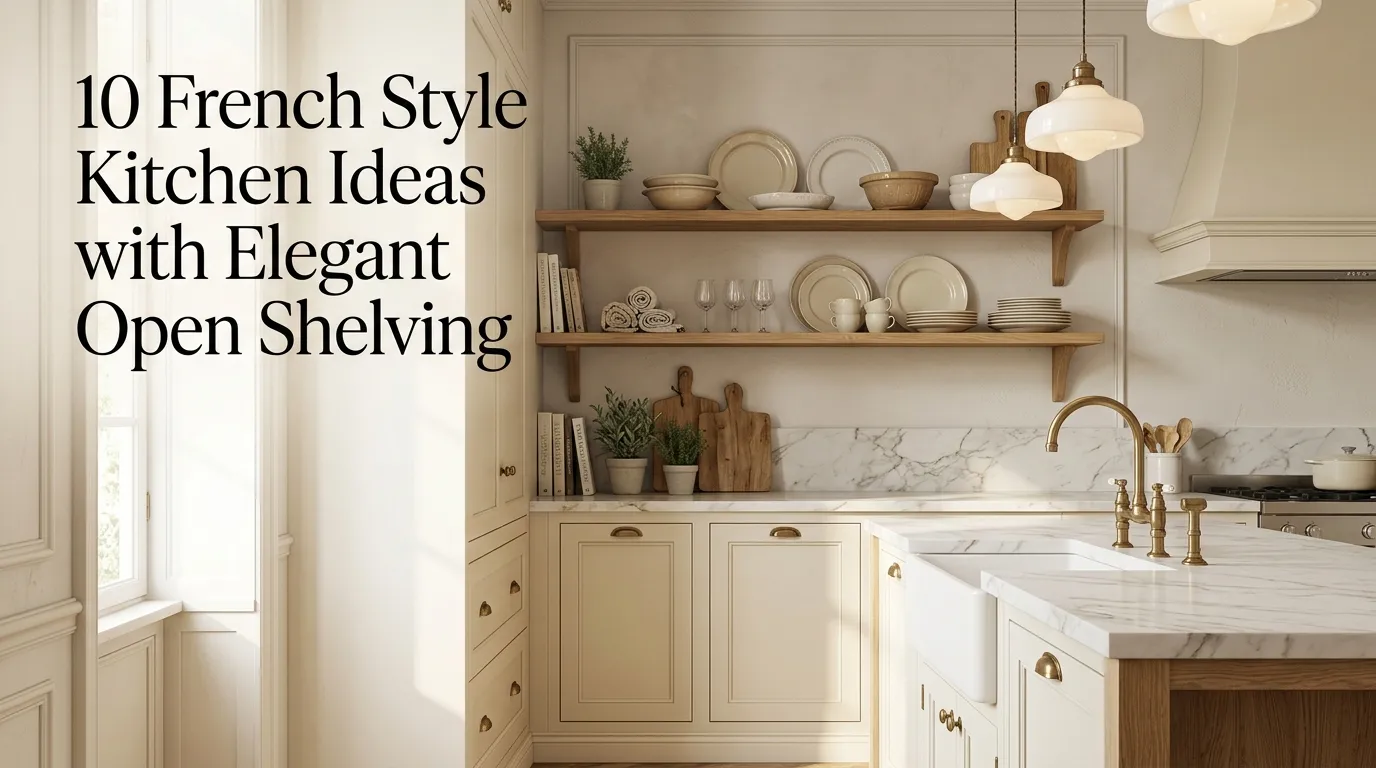
10 French Style Kitchen Ideas with Elegant Open Shelving
A French-inspired kitchen has a way of feeling collected rather than decorated. It can be elegant without being formal, practical without looking overly utilitarian, and charming without becoming overly rustic.
One of the details that captures this balance particularly well is open shelving. Instead of hiding every dish and glass behind cabinet doors, carefully styled shelves let everyday pieces become part of the room. A stack of cream plates, a few vintage-looking pitchers, wooden cutting boards, and simple pottery can add warmth while keeping the kitchen visually interesting.
The secret is restraint. Open shelving looks beautiful when there is enough space between objects and when the colors feel connected to the rest of the kitchen. French style also benefits from natural materials, aged finishes, soft neutrals, classic hardware, and pieces that look as though they have been gathered over time.
In my experience, the most successful French-inspired kitchens don’t depend on perfect matching. A little variation in texture and finish gives the room personality. The goal is to create a space that feels welcoming enough for everyday cooking but polished enough to become a natural gathering place.
Whether you’re updating a full kitchen or simply adding a couple of shelves to an existing space, these ideas can help you create that relaxed European character. You’ll find ways to combine open shelving with wood, marble-inspired surfaces, vintage accents, warm lighting, classic cabinetry, and practical storage.
The result can be a kitchen that feels timeless, layered, and distinctly personal without requiring every detail to come from the same collection.
Table of Contents
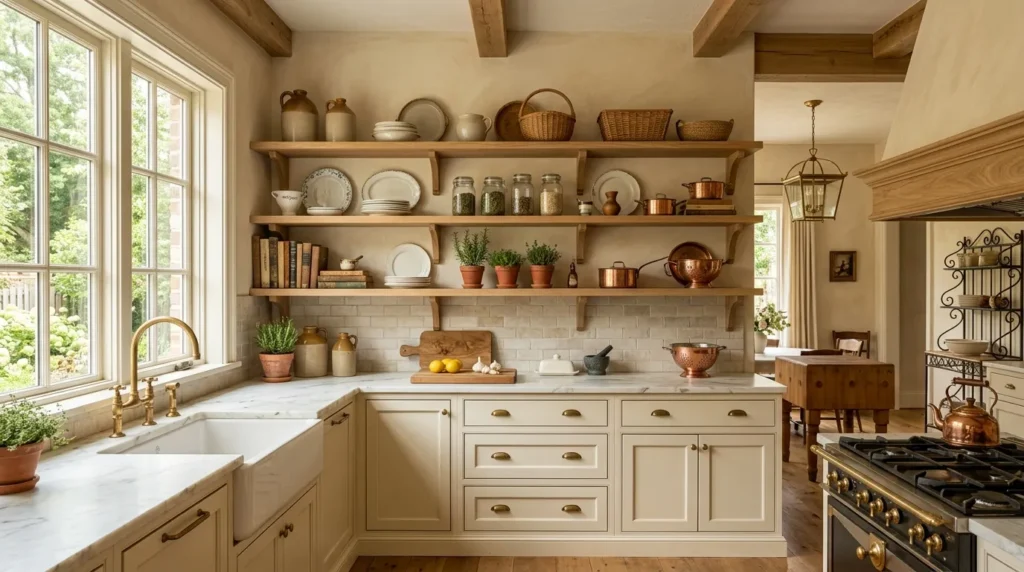
1. Natural Wood Shelves
Warm wood shelving brings organic texture and relaxed French character to the kitchen.
2. Creamy Cabinetry
Soft cabinet colors create an elegant backdrop for open shelves and collected accessories.
3. Vintage Dishware
Classic plates, pitchers, and serving pieces turn open shelves into functional decoration.
4. Marble Shelf Details
Stone surfaces add refinement while balancing the warmth of wood and ceramics.
5. Brass Hardware
Aged brass accents introduce subtle warmth and classic European character.
6. Layered Pottery Displays
Handmade-looking ceramics create texture and an authentic collected appearance.
7. Open Shelf Lighting
Warm lighting highlights shelves and creates a welcoming evening atmosphere.
8. Rustic Wood Accents
Cutting boards and wooden accessories soften polished kitchen finishes.
9. Arched Shelf Styling
Curved architectural details add softness and traditional French-inspired charm.
10. Collected Open Shelves
A balanced mixture of practical and decorative objects creates an effortless finished look.
1. Natural Wood Shelves
Quick Benefits
- Adds warmth to the kitchen
- Introduces natural texture
- Softens painted cabinetry
- Works with vintage and modern elements
- Provides practical everyday storage
Why It Works
Natural wood is one of the easiest ways to bring warmth into a French-inspired kitchen. Against cream, ivory, or muted cabinetry, wood shelves create a gentle contrast without feeling harsh.
The beauty comes from the material’s natural variation. Small knots, grain patterns, and slightly imperfect edges can make the kitchen feel more authentic and less manufactured.
Open wood shelves also create an opportunity to display useful objects rather than treating every decorative piece as something separate. Plates, bowls, jars, cutting boards, and pitchers can all contribute to the visual character of the room.
A common mistake is making shelves too deep or filling them completely. French-inspired styling usually benefits from breathing room and a relatively edited collection.
How To Style It
Choose shelves in natural oak, walnut, reclaimed wood, or another finish that coordinates with the flooring and cabinetry.
Two or three long shelves above a countertop can create a substantial focal point.
Arrange everyday dishes toward one side and taller objects toward another. Lean a wooden cutting board against the wall and place a ceramic pitcher nearby.
Use a combination of horizontal and vertical pieces to keep the display from looking rigid.
Leave some empty wall space between groups.
For a softer French country appearance, choose wood with visible grain and a lightly aged finish. For a more refined interpretation, use smooth natural wood with clean edges.
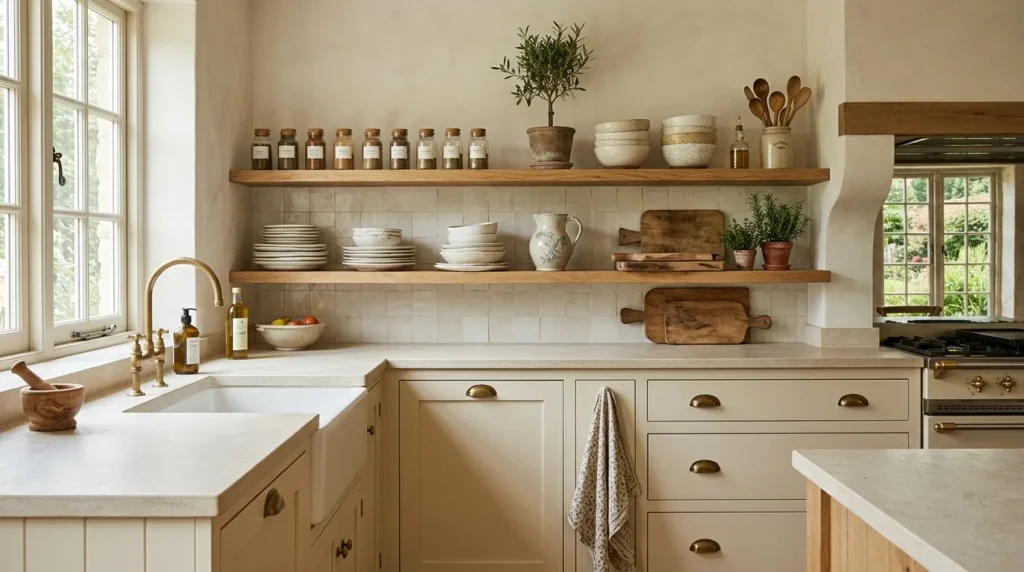
2. Creamy Cabinetry
Quick Benefits
- Creates a soft backdrop
- Makes open shelves stand out
- Works with natural materials
- Feels timeless
- Complements warm metals
Why It Works
Bright white can sometimes feel stark, particularly when paired with dark wood or strong black accents. Cream, ivory, and warm off-white cabinetry create a gentler foundation for French-inspired kitchens.
These shades work beautifully with the materials commonly associated with the style: wood, stone, ceramic, linen, and aged metal.
They also allow open shelving to become part of the overall composition rather than looking like an unrelated addition.
The combination of warm cabinetry and open shelves creates a relaxed contrast between painted surfaces and natural materials.
This approach works in both traditional and updated kitchens.
How To Style It
Choose cabinetry in a warm neutral rather than a cool blue-based white.
Pair the cabinets with wood shelves and simple brass or bronze hardware.
On the shelves, repeat the cabinet’s warmth through cream pottery, ivory dishes, and beige textiles.
If the countertops are patterned or visually strong, keep the shelf styling relatively simple.
For a classic appearance, consider shaker-style cabinet doors or another understated profile.
Add one or two darker elements—such as a black-framed print or dark wood cutting board—to prevent the palette from becoming too uniform.
Keep the ceiling and larger surrounding surfaces relatively light so the kitchen retains an airy appearance.
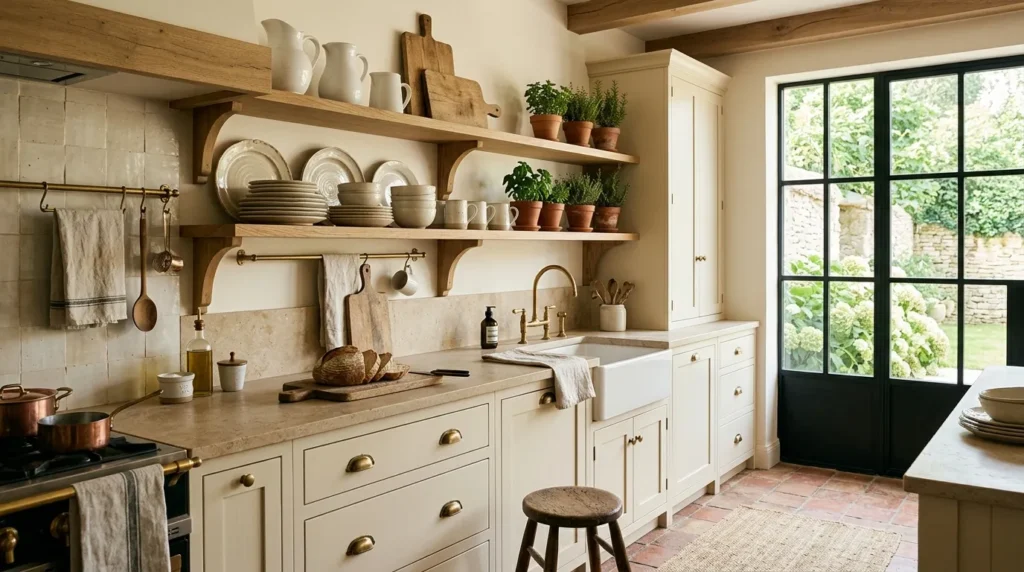
3. Vintage Dishware
Quick Benefits
- Adds personality
- Makes shelves functional
- Creates a collected appearance
- Introduces subtle color
- Supports a traditional French aesthetic
Why It Works
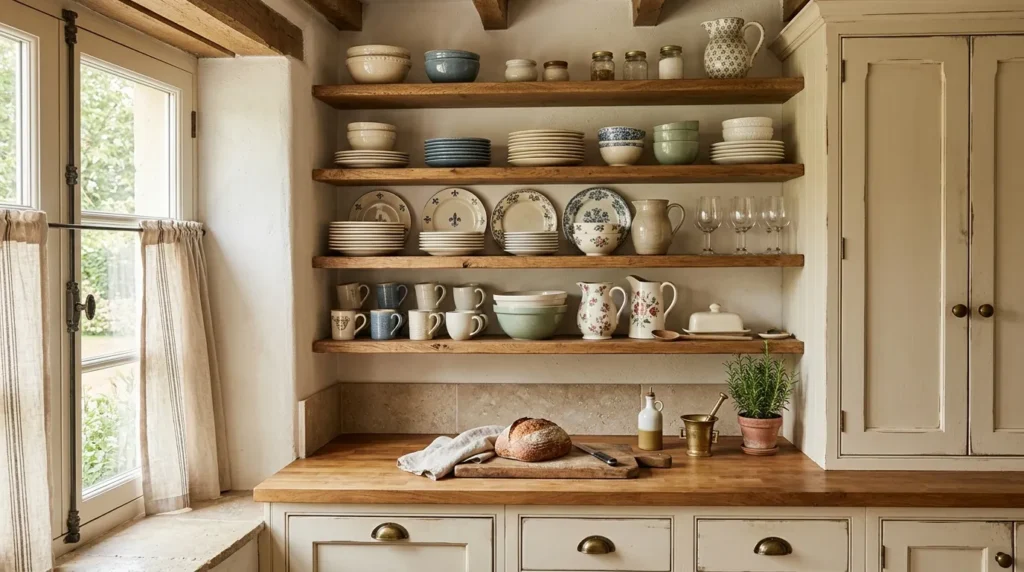
Open shelves are at their best when they display things you actually use.
Vintage-inspired plates, bowls, pitchers, serving dishes, and glasses can make an everyday kitchen feel more personal.
The goal isn’t to create a museum-like display. Slight variations in shape, glaze, and color can make the arrangement feel collected over time.
Creamy white dishes are particularly versatile because they work with nearly any kitchen palette.
Blue-and-white ceramics, muted florals, soft green pottery, and warm terracotta can introduce small amounts of color without overwhelming the room.
How To Style It
Start with the pieces you already own.
Stack plates in groups of three to six. Place bowls beside them and add one taller pitcher or vase to create vertical interest.
If you’re mixing patterns, keep the colors related.
For example, several different ceramic patterns can still look cohesive when they share cream and muted blue tones.
Avoid creating a shelf where every item faces forward like a store display. Some objects can be stacked, while others can lean or sit naturally.
Leave gaps between groups so the eye can distinguish each collection.
The slightly imperfect arrangement is part of the charm.
4. Marble Shelf Details
Quick Benefits
- Adds refined texture
- Creates a luxurious contrast
- Works with brass and wood
- Brightens the kitchen
- Adds visual interest without excessive decoration
Why It Works
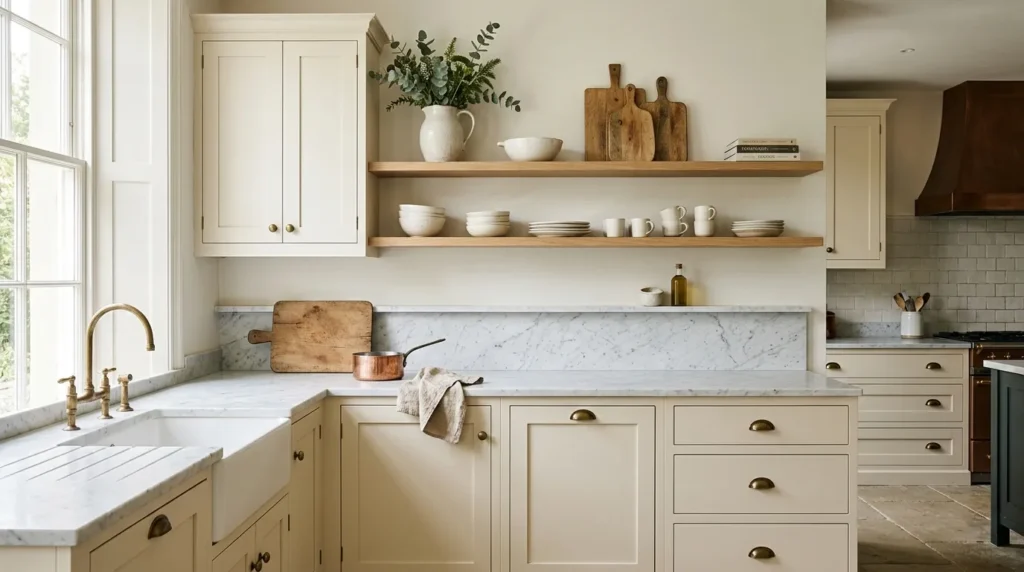
Marble introduces a sense of refinement that pairs beautifully with the relaxed warmth of French-inspired design.
The key is balance. Too much polished stone can make the kitchen feel formal, while a small amount can elevate more rustic materials.
A marble shelf, marble backsplash, or stone ledge can work particularly well alongside natural wood shelves and creamy cabinetry.
Soft veining tends to be especially versatile because it adds movement without competing with open-shelf displays.
How To Style It
If your kitchen already has a marble countertop or backsplash, repeat the material subtly rather than adding another competing stone.
Pair light marble with warm wood, cream ceramics, and aged brass.
Keep the shelf objects relatively simple so the stone remains visible.
A ceramic pitcher, a small vase of greenery, and a stack of neutral plates can be enough.
For a more relaxed appearance, combine polished stone with imperfect handmade-looking pottery.
Avoid filling every available surface. The empty portions of marble help create the elegant feeling.
5. Brass Hardware
Quick Benefits
- Adds warmth
- Complements cream cabinetry
- Creates classic character
- Works with wood and stone
- Adds a subtle decorative detail
Why It Works
Hardware may be small, but it can influence the entire visual language of a kitchen.
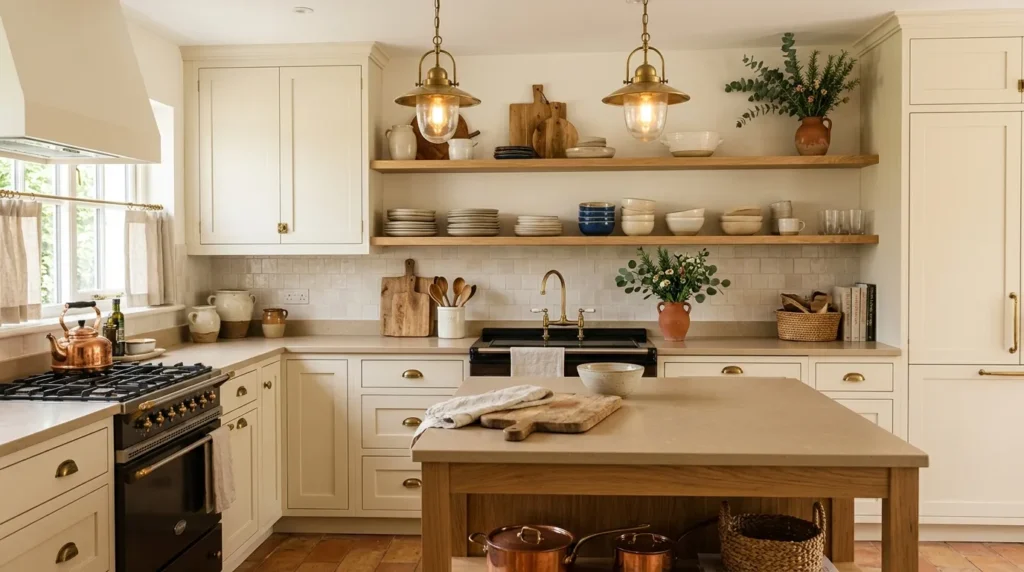
Aged brass, unlacquered brass, and warm bronze finishes can introduce the traditional character associated with European kitchens.
Against creamy cabinetry, brass has enough contrast to remain visible without feeling severe.
It also works naturally with wood, marble, ceramic, and warm lighting.
The important thing is repetition. A small number of related metal details can create cohesion.
How To Style It
Use brass for cabinet knobs, pulls, faucets, shelf brackets, or lighting.
You don’t need every metal element to match perfectly. Slight variation can work in a collected kitchen, provided the overall tones remain compatible.
Pair brass hardware with warm white cabinets and natural wood shelves.
Keep the shelf accessories mostly neutral so the metal becomes a subtle accent.
For a more traditional appearance, choose hardware with gently rounded forms.
For a cleaner interpretation, slim pulls and simple knobs provide the same warmth with less ornamentation.
6. Layered Pottery Displays
Quick Benefits
- Adds handmade character
- Introduces texture
- Makes shelves feel collected
- Works with neutral palettes
- Creates visual depth
Why It Works
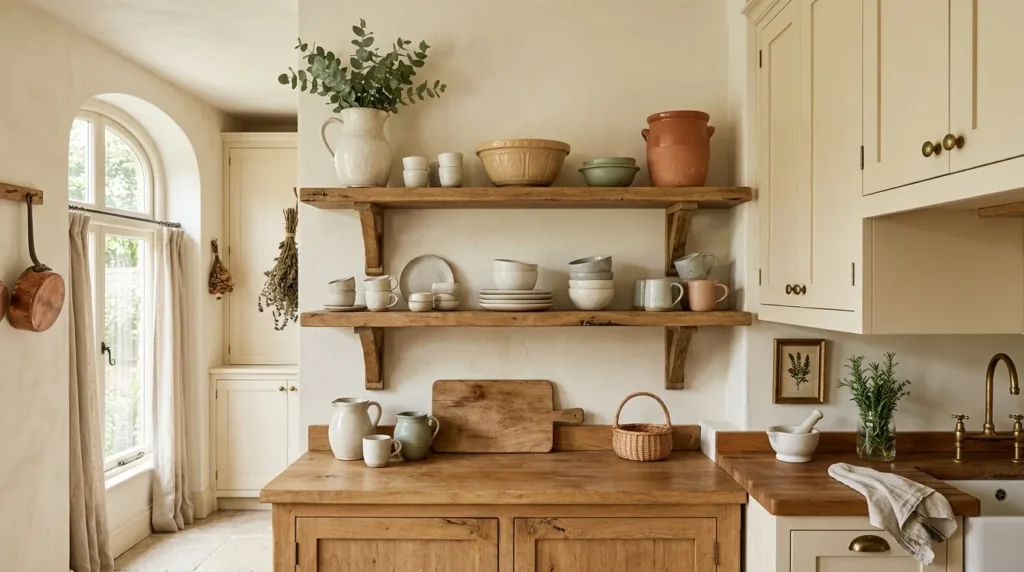
Pottery is almost perfectly suited to French-inspired open shelving because it combines function, texture, and imperfection.
Handmade-looking ceramics have slight variations that make a shelf feel more natural.
Instead of displaying ten identical pieces, combine different shapes within a related palette.
A wide bowl, narrow vase, small pitcher, and simple cup can create visual variety without requiring bold colors.
Neutral pottery also works especially well when the kitchen already has wood, stone, and painted cabinetry.
How To Style It
Choose three or four ceramic finishes rather than trying to match every piece.
Cream, oatmeal, pale gray, muted sage, and soft terracotta are useful starting points.
Place larger pottery toward the back or at the ends of the shelf. Smaller objects can fill the spaces between.
Use a few stacked plates or bowls to add horizontal lines.
A small vase filled with fresh herbs or delicate greenery can soften the arrangement.
Keep some shelves intentionally sparse.
The goal is a display that feels useful and naturally gathered rather than carefully staged.
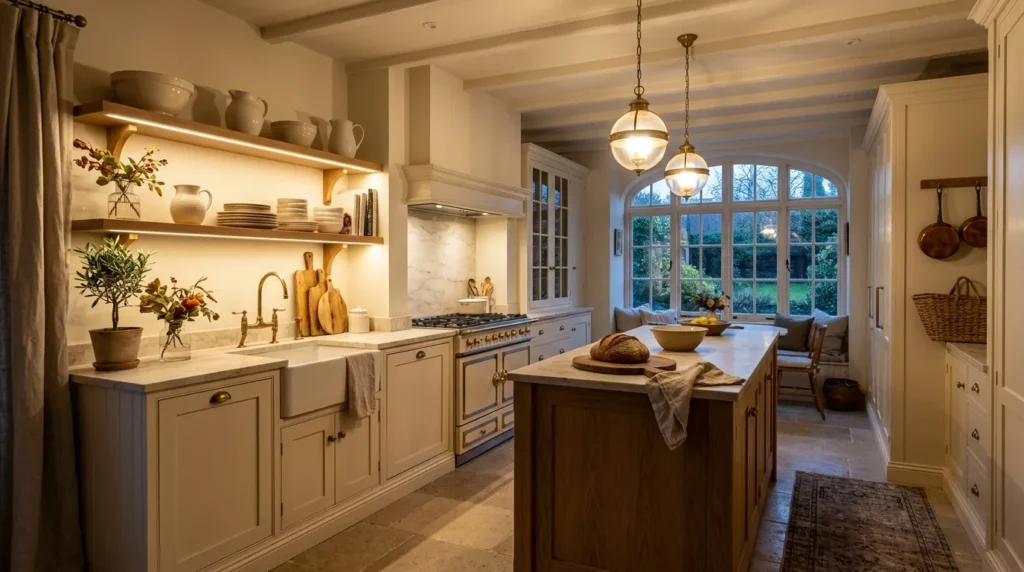
7. Open Shelf Lighting
Quick Benefits
- Highlights shelf displays
- Creates evening ambiance
- Adds warmth
- Improves task visibility
- Makes the kitchen feel layered
Why It Works
Lighting can dramatically change how open shelving looks after sunset.
Without adequate illumination, shelves can become dark areas that visually disappear into the wall. Warm accent lighting makes the objects visible and adds another layer to the kitchen.
This is particularly effective in kitchens with warm cabinetry and natural wood.
Under-shelf lighting can also provide practical illumination for countertops.
The key is keeping the light soft enough to complement the room rather than making the shelves look like a display cabinet.
How To Style It
Consider discreet LED strip lighting beneath shelves where practical.
Warm white lighting generally complements cream cabinetry, wood, and brass beautifully.
Hide cords and hardware as much as possible for a cleaner appearance.
Use lighting selectively. You don’t necessarily need every shelf illuminated.
If you have pendant lights over an island, coordinate their warmth and finish with the shelf lighting.
In the evening, allow the shelf lighting to become a secondary source rather than relying entirely on bright overhead fixtures.
This creates a softer, more welcoming atmosphere for dinners and entertaining.
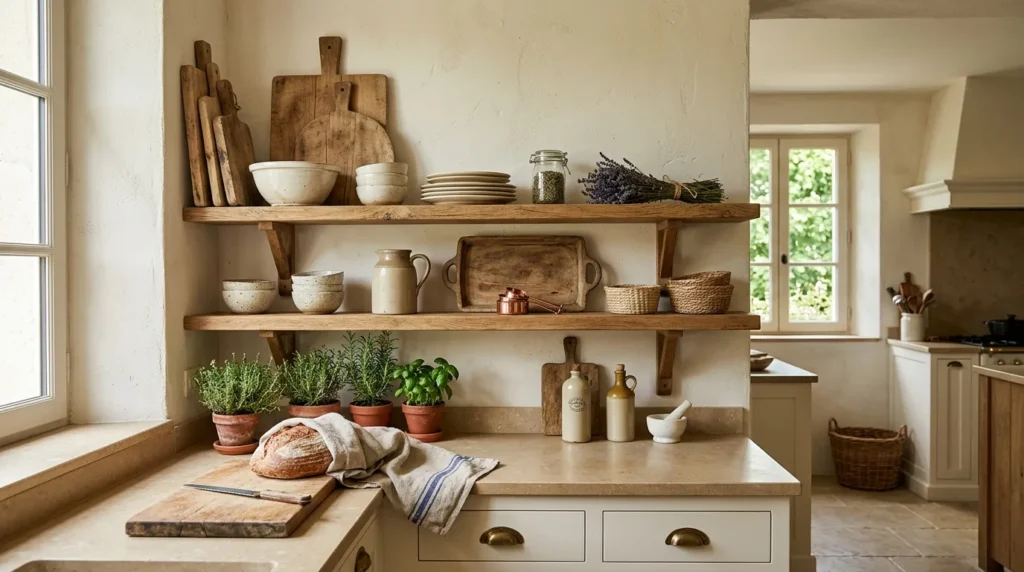
8. Rustic Wood Accents
Quick Benefits
- Adds warmth
- Creates visual texture
- Supports practical styling
- Softens polished finishes
- Works beautifully with ceramics
Why It Works
Wooden cutting boards, bread boards, serving paddles, stools, and small trays can introduce the kind of natural texture that makes a kitchen feel lived-in.
These pieces are particularly useful on open shelves because they provide strong vertical and horizontal shapes.
A collection of wooden boards leaning against the backsplash can become part of the decor while remaining completely functional.
The trick is using a limited number of wood tones.
Too many unrelated finishes can make the kitchen feel chaotic.
How To Style It
Lean two or three cutting boards against the wall at the back of a shelf.
Place a ceramic bowl or pitcher in front of one edge to create layering.
Choose boards with slightly different shapes but related wood tones.
Repeat the wood finish elsewhere in the room through stools, handles, flooring, or a small table.
If the kitchen already contains substantial wood cabinetry, use lighter or more restrained wooden accessories.
Keep the boards clean and suitable for their intended food use.
The result should feel naturally useful rather than purely decorative.
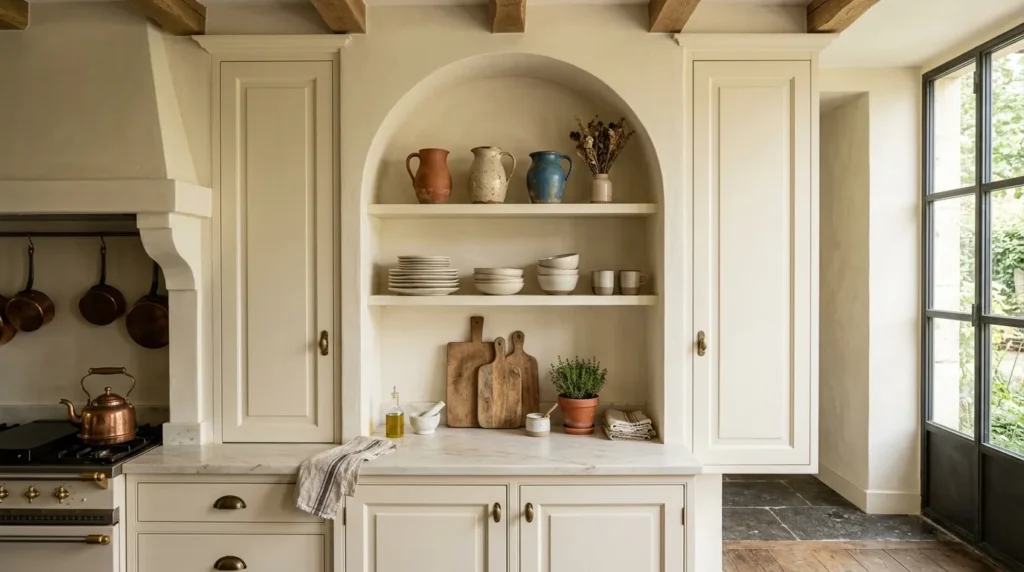
9. Arched Shelf Styling
Quick Benefits
- Adds architectural softness
- Creates a distinctive focal point
- Works in traditional kitchens
- Introduces gentle curves
- Makes open storage feel built-in
Why It Works
Curves can soften the straight lines found throughout most kitchens.
An arched niche, curved shelving unit, or rounded shelf opening can create a beautiful architectural feature while providing practical storage.
This shape works particularly well with French-inspired interiors because it complements traditional details without requiring ornate decoration.
An arch can also frame the shelf display, making ordinary kitchenware feel more intentional.
How To Style It
If you’re remodeling, consider a shallow arched niche with two or three shelves.
For a simpler update, use an arched freestanding shelf or an appropriately sized curved wall unit.
Paint the interior of the niche in a slightly deeper neutral if you want the objects to stand out.
Use pottery, stacked plates, glassware, and a few wooden pieces inside.
Keep the palette restrained.
A small vase of greenery at the center can provide a natural focal point.
Avoid filling the entire arch with objects. Let the architectural shape remain visible.
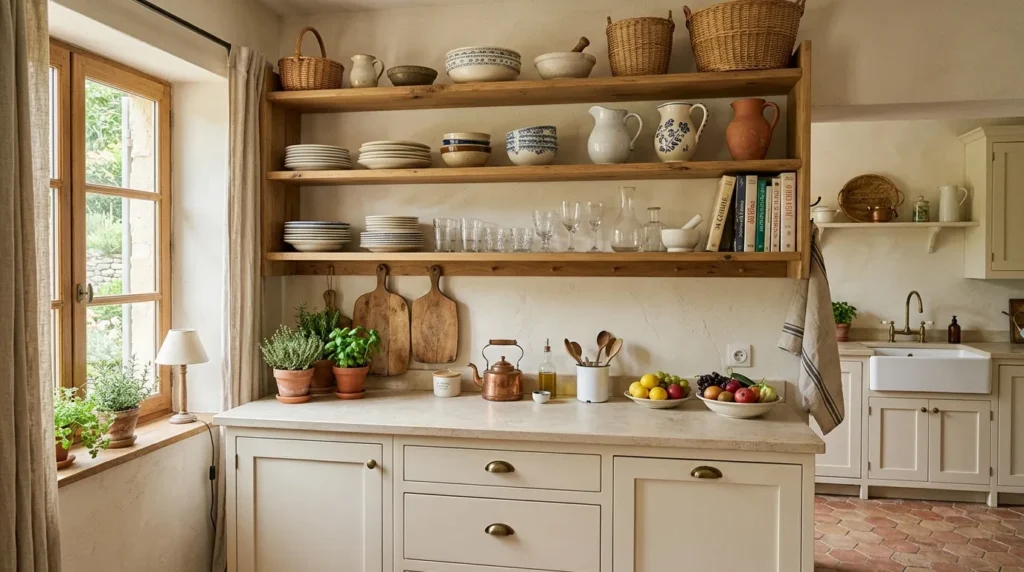
10. Collected Open Shelves
Quick Benefits
- Creates an authentic lived-in look
- Combines function and decoration
- Allows personality to show
- Works with many French-inspired styles
- Can evolve over time
Why It Works
The most convincing French-inspired kitchens rarely look as though every object was purchased at the same time.
A collected shelf feels more natural because it includes a mixture of practical pieces, inherited-looking objects, ceramics, books, wood, and greenery.
This doesn’t mean the display is random. The color palette and proportions provide the structure.
A useful rule is to combine different heights and textures while repeating a few colors.
The shelf should look beautiful, but it should also look like someone actually uses the kitchen.
How To Style It
Begin with everyday essentials: plates, bowls, glasses, mugs, and serving pieces.
Add one or two decorative elements, such as a ceramic vase or small framed artwork.
Include natural materials like wood and woven baskets.
Use greenery sparingly. Fresh herbs in a small pot can be both attractive and useful.
Arrange objects in groups rather than lining everything up evenly.
Leave some negative space.
Then live with the shelves for a while. If you notice something you use frequently, move it to a convenient position.
The best open shelving evolves naturally with the way your kitchen is used.
How To Style Open Shelving Without Making It Look Cluttered
Open shelving can look elegant, but it requires more editing than closed cabinetry.
Start by choosing a limited palette. French-inspired kitchens often look beautiful with combinations such as:
- Cream + natural wood + brass
- Ivory + muted blue + oak
- Beige + terracotta + aged brass
- Soft white + sage + walnut
- Warm gray + cream + natural stone
Then vary the shapes rather than constantly adding new colors.
For example, a shelf can contain a stack of round plates, a tall pitcher, a rectangular cutting board, and a small bowl.
This creates visual rhythm.
Another useful technique is layering. Place taller pieces toward the back and smaller pieces toward the front.
Avoid putting every object at exactly the same height.
And remember that empty space is part of the design. A shelf that is 70–80% occupied can often look more polished than one filled completely from end to end.
French Kitchen Materials That Work With Open Shelves
Material selection plays a major role in creating the right atmosphere.
Natural Wood
Adds warmth and an organic quality.
Marble
Provides elegant movement and a refined surface.
Ceramic
Introduces handmade texture and everyday practicality.
Brass
Adds warm metallic detail.
Linen
Softens the harder surfaces of stone and cabinetry.
Terracotta
Brings earthy color and relaxed European character.
Wrought Iron
Adds structure and contrast, especially in traditional spaces.
The most successful combinations usually mix several of these materials without allowing any single one to dominate.
Common Open Shelving Mistakes
Filling Every Shelf
Too many objects make the display visually heavy.
Using Too Many Colors
A broad color palette can make individual objects compete.
Ignoring Practicality
Frequently used dishes belong within easy reach.
Matching Everything
Perfectly matching objects can make a kitchen feel more like a showroom than a home.
Using Shelves That Are Too Deep
Deep shelves can make a small kitchen feel crowded.
Forgetting Cleaning
Open shelves collect dust more readily than closed cabinets. Choose objects you can comfortably clean and rotate.
Mixing Too Many Materials
Wood, stone, metal, ceramic, glass, and woven materials can coexist, but repeating a few key finishes creates more cohesion.
FAQ
How do you make open shelving look French?
Use natural materials, warm neutral colors, vintage-inspired dishware, ceramics, wood, aged brass, and a restrained collection of practical objects. Avoid overly perfect arrangements. A slightly collected appearance feels more authentic while still benefiting from consistent colors, balanced proportions, and plenty of negative space.
What color cabinets work best with French-style kitchens?
Cream, ivory, warm white, beige, muted sage, soft gray, and other warm neutrals work especially well. These colors provide a gentle backdrop for natural wood, ceramic, stone, and brass. The best choice depends on the kitchen’s natural light and existing materials.
What should I put on open kitchen shelves?
Display a combination of items you actually use and a few decorative pieces. Plates, bowls, mugs, glasses, pitchers, cutting boards, serving pieces, pottery, small plants, and cookbooks can all work. Group similar items together and leave enough empty space to prevent the shelves from looking crowded.
Are open shelves practical in a kitchen?
They can be practical when used selectively. Everyday dishes are easy to access, while less frequently used items can remain in closed cabinets. Open shelving does require more regular dusting than enclosed storage, so choosing easy-to-clean pieces can make maintenance simpler.
What wood looks best in a French-style kitchen?
Natural oak, reclaimed wood, walnut, and lightly weathered finishes can all work. Lighter woods create an airy appearance, while darker wood adds contrast and depth. Choose a finish that relates to the existing flooring, furniture, or other wood elements rather than introducing too many unrelated tones.
How do I keep open shelves from looking cluttered?
Limit the number of colors, group objects by function, vary heights, and leave intentional empty space. Use larger pieces as anchors and smaller pieces as accents. If a shelf feels crowded, remove several objects rather than trying to rearrange everything.
Can French-style kitchen decor work in a modern home?
Absolutely. You can combine traditional French details with modern cabinetry, clean countertops, contemporary lighting, and streamlined shelving. The style comes from the combination of materials, colors, proportions, and decorative choices rather than requiring an entirely traditional kitchen.
Conclusion
French-inspired kitchen design is less about creating a perfectly styled room and more about creating a space with warmth, character, and thoughtful details.
Open shelving is one of the easiest ways to introduce that feeling because it allows everyday objects to become part of the kitchen’s visual story. Creamy cabinetry, natural wood, vintage-inspired ceramics, aged brass, marble, greenery, and warm lighting all work together to create a layered appearance.
The key is restraint. Choose a few materials and colors that complement each other. Give frequently used dishes a convenient place. Add decorative pieces slowly. Leave open space between collections so the shelves can breathe.
You don’t need a complete kitchen renovation to introduce French-inspired character. Even two wood shelves above a counter can change the feel of the room when they’re styled with the right combination of pottery, wood, greenery, and warm neutrals.
Start with the area that feels most empty or unfinished. Add one intentional shelf arrangement, then build from there.
The result can be elegant without feeling formal, practical without feeling plain, and beautifully collected without looking overly designed.
Related Articles
- 10 French Style Kitchen Ideas with Charming Vintage Details
- 10 Modern Kitchen Ideas with Warm Neutral Colors
- 10 Blue Gray Kitchen Cabinets with Timeless Design
- 10 Kitchen Shelf Decor Ideas for a Warm and Organized Space
- 10 Small Kitchen Ideas That Feel Open and Stylish